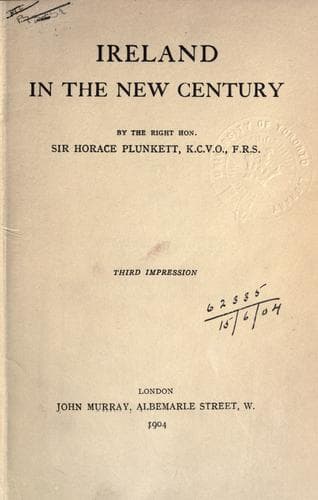
Ireland In The New CenturyPlunkett, Horace Curzon, Sir
History
Ireland In The New Century
Plunkett, Horace Curzon, Sir
Ireland -- Economic conditions; Ireland -- Politics and government -- 1901-1910; Irish question
These societies consist, as has been explained, of groups of farmers who
have been taught by organisers that certain branches of their business
can be more profitably conducted in association than by individuals
acting separately. The principle of agricultural co-operation with its
economic advantages will, as time goes on, be further extended by the
combined action of societies. With this end in view federations are
constantly being formed with a constitution similar to that of the
societies, the only difference being that the members of the federation
are not individuals but societies, the government of the central body
being carried on by delegates from its constituent associations. The two
largest of these federations, one for the sale of butter, and another
for the combined purchase by societies of their agricultural
requirements, have been working successfully for several years.
Federations, too, are being formed, as societies find that their
business can be conducted more economically, for example, in dairying by
centralising the manufacture of butter, or in the egg export trade by
the alliance of many districts to enable large contracts to be
undertaken. In the near future a further development of federation will
be required to complete a scheme now under consideration for the mutual
insurance of live stock. Such a scheme involves the existence of two
prime conditions, a local organisation for the purpose of effective
supervision, and the spreading of the risk over a large area.
In all such enterprises and economic changes the Organisation Society is
either the initiator, or is called in for advice, and its continued
existence in a purely advisory capacity as a link between the societies
where concerted action is required, will be necessary even when the
organisation of farmers into societies is completed. The economic life
of rural communities is in continual need of adjustment. Now it is an
invention like a steam separator which revolutionises an industry. At
another time the crisis created by a change in the tariff of a foreign
country forces the producer either to find a new outlet for his wares,
or to abandon a hitherto profitable employment. A striking instance of
the value of organisation and connection with a central advisory body
occurred in 1887, when swine fever broke out in Denmark, and the exports
of live swine fell from 230,000 in one year to 16,000 in the next. The
organisation of the farmers, however, enabled them easily to consult
together how best to meet the emergency, and their decision to start
co-operative bacon-curing factories was the foundation of their present
great export trade in manufactured bacon.
Public-domain text, read in full here on John Shaqi.
Reviews
Reviews
No reviews yet
Be the first to share your thoughts on this work.
Elsewhere in the archive
Join the Discussion
Join the discussion
Sign in to leave a comment or review.
Sign InorCreate an account