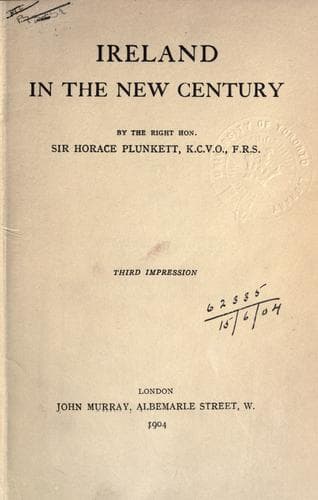
Ireland In The New CenturyPlunkett, Horace Curzon, Sir
History
Ireland In The New Century
Plunkett, Horace Curzon, Sir
Ireland -- Economic conditions; Ireland -- Politics and government -- 1901-1910; Irish question
Raiffeisen held, and our experience in Ireland has fully confirmed his
opinion, that in the poorest communities there is a perfectly safe basis
of security in the honesty and industry of its members. This security is
not valuable to the ordinary commercial lender, such as the local joint
stock bank. Even if such lenders had the intimate knowledge possessed by
the committee of one of these associations as to the character and
capacity of the borrower, they would not be able to satisfy themselves
that the loan was required for a really productive purpose, nor would
they be able to see that it was properly applied to the stipulated
object. One of the rules of the co-operative banks provides for the
expulsion of a member who does not apply the money to the agreed
productive purpose. But although these "Banks" are almost invariably
situated in very poor districts, there has been no necessity to put this
rule in force in a single instance. Social influences seem to be quite
sufficient to secure obedience to the association's laws.
Another advantage conferred by the association is that the term for
which money is advanced is a matter of agreement between the borrower
and the bank. The hard and fast term of three months which prevails in
Ireland for small loans is unsuited to the requirements of the
agricultural industry--as for instance, when a man borrows money to sow
a crop, and has to repay it before harvest. The society borrows at four
or five per cent, and lends at five or six per cent. In some cases the
Congested Districts Board or the Department of Agriculture have made
loans to these banks at three per cent. This enables the societies to
lend at the popular rate of one penny for the use of one pound for a
month. The expenses of administration are very small. As the credit of
these associations develops, they will become a depository for the
savings of the community, to the great advantage of both lender and
borrower. The latter generally makes an enormous profit out of these
loans, which have accordingly gained the name of 'the lucky money,' and
we find, in practice, that he always repays the association and almost
invariably with punctuality.
Public-domain text, read in full here on John Shaqi.
Reviews
Reviews
No reviews yet
Be the first to share your thoughts on this work.
Elsewhere in the archive
Join the Discussion
Join the discussion
Sign in to leave a comment or review.
Sign InorCreate an account