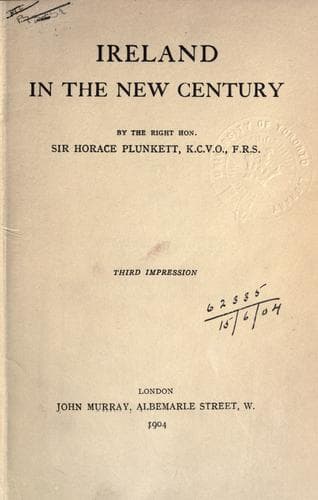
Ireland In The New CenturyPlunkett, Horace Curzon, Sir
History
Ireland In The New Century
Plunkett, Horace Curzon, Sir
Ireland -- Economic conditions; Ireland -- Politics and government -- 1901-1910; Irish question
The sketch I have given of the agricultural banks will, perhaps, be
sufficient to show what an immense educational and economic benefit they
are likely to confer when they are widely extended throughout Ireland,
as I hope they will be in the near future. Under this system, which, to
quote the report of the Indian Famine Commission, 1901, 'separates the
working bees from the drones,' the industrious men of the community who
had no clear idea before of the meaning or functions of capital or
credit, and who were generally unable to get capital into their industry
except at exorbitant rates of interest and upon unsuitable terms, are
now able to get, not always, indeed, all the money they want, but all
the money they can well employ for the improvement of their industry.
There is no fear of rash investment of capital in enterprises believed
to be, but not in reality productive--the committee take good care of
that. The whole community is taught the difference between borrowing to
spend and borrowing to make. You have the collective wisdom of the best
men in the association helping the borrower to decide whether he ought
to borrow or not, and then assisting him, if only from motives of
self-interest, to make the loan fulfil the purpose for which it was
made. I was delighted to find when I was making an enquiry into the
working of the system that, whereas the debt-laden peasants had formerly
concealed their indebtedness, of which they were ashamed, those who were
in debt to the new banks were proud of the fact, as it was the best
testimonial to their character for honesty and industry.[39]
One other sphere of activity worked by the co-operative associations
needs a passing notice. The desire that, together with material
amelioration, there should be a corresponding intellectual advancement
and a greater beauty in life has prompted many of the farmers' societies
to use their organisation for higher ends. A considerable number of them
have started Village Libraries, and by an admirable selection of books
have brought to their members, not only the means of educating
themselves in the more difficult technical problems of their industry,
but also a means of access to that enchanted world of Irish thought
which inspires the Gaelic Revival to which I have already referred.
Social gatherings of every kind, dances, lectures, concerts, and such
like entertainments, which have the two-fold effect of brightening rural
life and increasing the attachment of the members to their society, are
becoming a common feature in the movement, and this more human aspect
has attracted to it the attention of many who do not understand its
economic side. We have gratifying evidence from many of the clergy that
the movement thus developed has kept at home young people who would
otherwise have fled from the continued hardship and intellectual
emptiness of rural life at home.
Public-domain text, read in full here on John Shaqi.
Reviews
Reviews
No reviews yet
Be the first to share your thoughts on this work.
Elsewhere in the archive
Join the Discussion
Join the discussion
Sign in to leave a comment or review.
Sign InorCreate an account