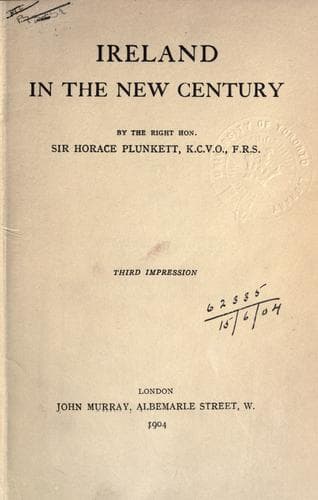
Ireland In The New CenturyPlunkett, Horace Curzon, Sir
History
Ireland In The New Century
Plunkett, Horace Curzon, Sir
Ireland -- Economic conditions; Ireland -- Politics and government -- 1901-1910; Irish question
for the first time on a footing of friendly equality, as fellow-members
of co-operative societies. It is significant that all through the
negotiations which culminated in the Dunraven Treaty, landlords who had
come into the life of the people in connection with the co-operative
movement took a prominent part in favour of conciliation.
I would further give it as my opinion, whatever it may be worth, that
the movement has exercised a profound influence in those departments of
our national life where, as I have shown in previous chapters, new
forces must be not only recognised but accepted as essential to national
well-being, if we are to cherish what is good and free ourselves from
what is bad in the historical evolution of our national life. In the
domain of politics it is hard to estimate even the political value of
the exclusion of politics from deliberations and activities where they
have no proper place. In our religious life, where intolerance has
perpetuated anti-industrial tendencies, the new movement is seen to be
bringing together for business purposes men who had previously no
dealings with each other, but who have now learned that the doctrine of
self-help by mutual help involves no danger to faith and no sacrifice of
hope, while it engenders a genuinely Christian interpretation of
charity.[42]
I cannot conclude the story of this movement without paying a brief
tribute of respect and gratitude to those true patriots who have borne
the daily burden of the work. I hope the picture I have given of their
aims and achievements will lead to a just appreciation of their services
to their country. By these men and women applause or even recognition
was not expected or desired: they knew that it was to those who had the
advantages of leisure, and what the world calls position, that the
credit for their work would be given. But it is of national importance
that altruistic service should be understood and given freedom of
expansion. I have, therefore, presented as faithfully as I could the
origin and development of one of the least understood, but in my
opinion, most fruitful movements which has ever been undertaken by a
body of social and economic reformers. As Irish leaders they have
preferred to remain obscure, conscious that the most damaging criticism
which could be applied to their work would be that it depended on their
own personal qualities or acts for its permanent utility. But most
assuredly the real conquerors of the world are those who found upon
human character their hopes of human progress.
FOOTNOTES:
Public-domain text, read in full here on John Shaqi.
Reviews
Reviews
No reviews yet
Be the first to share your thoughts on this work.
Elsewhere in the archive
Join the Discussion
Join the discussion
Sign in to leave a comment or review.
Sign InorCreate an account