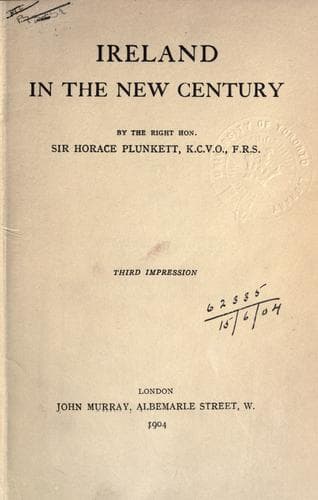
Ireland In The New CenturyPlunkett, Horace Curzon, Sir
History
Ireland In The New Century
Plunkett, Horace Curzon, Sir
Ireland -- Economic conditions; Ireland -- Politics and government -- 1901-1910; Irish question
[37] The story of the conversion of some of the tenants on the Vandeleur
estate into a co-operative community in 1831 by Mr. E.T. Craig, a
Scotchman who took up the agency of the property, told in the _History
of Ralahine_ (London, Trübner & Co., 1893) is worth reading. The
experiment, most hopeful as far as it went, was only two years in
existence when the landlord gambled away his property at cards in a
Dublin club and the Utopia was sold up. But in the co-operative world
Mr. Craig, who died as recently as 1894, is revered as the author of the
most advanced experiment in the realisation of co-operative ideals. The
economic significance of the narrative is obviously not important, and I
doubt whether joint ownership of land, except for the purpose of common
grazing, is a practical ideal. The ready response, however, of the Irish
peasants to Mr. Craig's enthusiasm and the way in which they took up the
idea form an interesting study of the Irish character.
[38] The late Canon Bagot had done good service in explaining the value
of the new machinery; but unhappily the vital importance of co-operative
organisation was not then understood. He formed some joint stock
companies with the result that, having no co-operative spirit to offset
their commercial inexperience, they all proved, instead of co-operative
successes, competitive failures. This fact added to our early
difficulties.
[39] It should be noted that this form of association for credit
purposes, owing to its peculiar constitution, applies only to a grade of
the community whose members all live on about the same scale and that a
fairly low one. It is obvious that unlimited liability would lose its
efficacy in developing the sense of responsibility if some members of
the association were so substantial that its creditors would make them
primarily responsible in the event of failure. The fact, however, that
the scheme has worked with unvarying success among the poorest of the
poor, and the most Irish of the Irish, renders it as good an
illustration as can be found of what may be done by sympathetic and
intelligent treatment of Irish economic problems. Mr. Henry W. Wolff,
the foremost authority on People's Banks in these islands, and Mr. R.A.
Yerburgh, M.P., a generous subscriber to the Irish Agricultural
Organisation Society, have taken great interest in this part of the
movement and have rendered much assistance.
[40] Those who wish to go more fully into the details of the
co-operative agricultural movement in Ireland should write to the
Secretary Irish Agricultural Organisation Society, 22 Lincoln-place,
Dublin. The publications of the Society are somewhat voluminous, and the
inquirer should intimate any particular branches of the subject in which
he is especially interested. Those wishing to keep _au courant_ with the
further development of the movement would do well to take in the _Irish
Homestead_, post free _6s. 6d._ per annum.
Public-domain text, read in full here on John Shaqi.
Reviews
Reviews
No reviews yet
Be the first to share your thoughts on this work.
Elsewhere in the archive
Join the Discussion
Join the discussion
Sign in to leave a comment or review.
Sign InorCreate an account