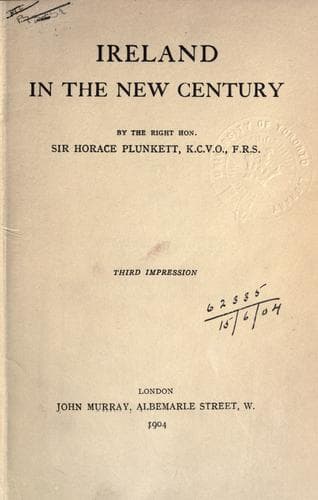
Ireland In The New CenturyPlunkett, Horace Curzon, Sir
History
Ireland In The New Century
Plunkett, Horace Curzon, Sir
Ireland -- Economic conditions; Ireland -- Politics and government -- 1901-1910; Irish question
[41] The chief donors belong to the class of philanthropists who do not
care to advertise their beneficence. I, therefore, respect their wishes
and withhold their names.
[42] I recall an occasion when the Vice-President of the I.A.O.S. (a
Nationalist in politics and a Jesuit priest), who has been ever ready to
lend a hand as volunteer organiser when the prior claims of his
religious and educational duties allowed, found himself before an
audience which he was informed, when he came to the meeting, consisted
mainly of Orangemen. He began his address by referring to the new and
somewhat strange environment into which he had drifted. He did not,
however, see why this circumstance should lead to any misunderstanding
between himself and his audience. He had never been able to understand
what a battle fought upon a famous Irish river two centuries ago had got
to do with the practical issues of to-day which he had come to discuss.
The dispute in question was, after all, between a Scotchman and a
Dutchman, and if it had not yet been decided, they might be left to
settle it themselves--that is if too great a gulf did not separate them.
CHAPTER VIII.
THE RECESS COMMITTEE.
The new movement, six years after its initiation, had succeeded beyond
the most sanguine expectations of its promoters. All over the country
the idea of self-help was taking firm hold of the imagination of the
people.
Co-operation had got, so to speak, into the air to such an extent that,
whereas at the beginning, as I well remember, our chief difficulty had
been to popularise a principle to which one section of the community was
strongly opposed, and in which no section believed, it was now no longer
necessary to explain or support the theory, but only to show how it
could be advantageously applied to some branch of the farmer's industry.
It was not, strange to say, the economic advantage which had chiefly
appealed to the quick intelligence of the Irish farmer, but rather the
novel sensation that he was thinking for himself, and that while
improving his own condition he was working for others. This attitude was
essential to the success of the movement, because had it not been for a
vein of altruism, the "strong" farmers would have held aloof, and the
small men would have been discouraged by the abstention of the
better-off and presumably more enlightened of their class.
Public-domain text, read in full here on John Shaqi.
Reviews
Reviews
No reviews yet
Be the first to share your thoughts on this work.
Elsewhere in the archive
Join the Discussion
Join the discussion
Sign in to leave a comment or review.
Sign InorCreate an account