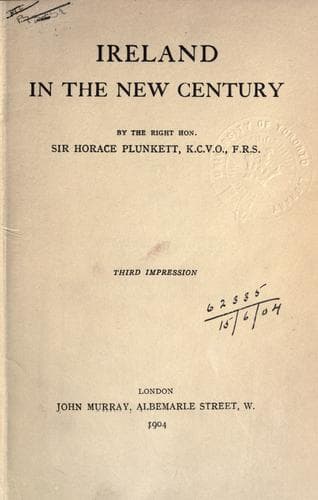
Ireland In The New CenturyPlunkett, Horace Curzon, Sir
History
Ireland In The New Century
Plunkett, Horace Curzon, Sir
Ireland -- Economic conditions; Ireland -- Politics and government -- 1901-1910; Irish question
The letter set out the general scope and purpose of the scheme. After a
confession of the writer's continued opposition to Home Rule, the
admission was made that if the average Irish elector, who is more
intelligent than the average British elector, were also as prosperous,
as industrious, and as well educated, his continued demand, in the
proper constitutional way, for Home Rule would very likely result in the
experiment being one day tried. On the other hand, the opinion was
expressed that if the material conditions of the great body of our
countrymen were advanced, if they were encouraged in industrial
enterprise, and were provided with practical education in proportion to
their natural intelligence, they would see that a political development
on lines similar to those adopted in England was, considering the
necessary relations between the two countries, best for Ireland; and
then they would cease to desire what is ordinarily understood as Home
Rule. A basis for united action between politicians on both sides of the
Irish controversy was then suggested. Finding ourselves still opposed
upon the main question, but all anxious to promote the welfare of the
country, and confident that, as this was advanced, our respective
policies would be confirmed, it would appear, it was suggested, to be
alike good patriotism and good policy to work for the material and
social advancement of the people. Why then, it was asked, should any
Irishman hesitate to enter at once upon that united action between men
of both parties which alone, under existing conditions, could enable
either party to do any real and lasting good to the country?
The letter proceeded to indicate economic legislation which, though
sorely needed by Ireland, was hopelessly unattainable unless it could be
removed from the region of controversy. The _modus co-operandi_
suggested was as follows:--a committee sitting in the Parliamentary
recess, whence it came to be known as the Recess Committee, was to be
formed, consisting in the first instance, of Irish Members of Parliament
nominated by the leaders of the different sections. These nominees were
to invite to join them any Irishmen whose capacity, knowledge, or
experience might be of service to the Committee, irrespective of the
political party or religious persuasion to which they might belong. The
day had come, the letter went on to say, when "we Unionists, without
abating one jot of our Unionism, and Nationalists, without abating one
jot of their Nationalism, can each show our faith in the cause for which
we have fought so bitterly and so long, by sinking our party differences
for our country's good, and leaving our respective policies for the
justification of time."
Public-domain text, read in full here on John Shaqi.
Reviews
Reviews
No reviews yet
Be the first to share your thoughts on this work.
Elsewhere in the archive
Join the Discussion
Join the discussion
Sign in to leave a comment or review.
Sign InorCreate an account