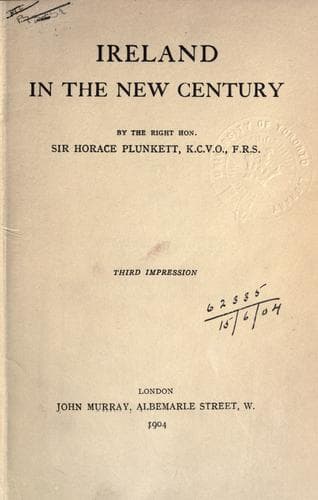
Ireland In The New CenturyPlunkett, Horace Curzon, Sir
History
Ireland In The New Century
Plunkett, Horace Curzon, Sir
Ireland -- Economic conditions; Ireland -- Politics and government -- 1901-1910; Irish question
Needless to say, few were sanguine enough to hope that such a committee
would ever be brought together. If that were accomplished some
prophesied that its members would but emulate the fame of the Kilkenny
cats. A severe blow was dealt to the project at the outset by the
refusal of Mr. Justin McCarthy, who then spoke for the largest section
of the Nationalist representatives, to have anything to do with it. His
reply to the letter must be given in full:--
MY DEAR MR. PLUNKETT,
I am sure I need not say that any effort to promote the general
welfare of Ireland has my fullest sympathy. I readily acknowledge
and entirely believe in the sincerity and good purpose of your
effort, but I cannot see my way to associate myself with it. Your
frank avowal in your letter of August 27th is the expression of a
belief that if your policy could be successfully carried out the
Irish people "would cease to desire Home Rule." Now, I do not
believe that anything in the way of material improvement conferred
by the Parliament at Westminster, or by Dublin Castle, could
extinguish the national desire for Home Rule. Still, I do not feel
that I could possibly take part in any organisation which had for
its object the seeking of a substitute for that which I believe to
be Ireland's greatest need--Home Rule.
Yours very truly,
JUSTIN MCCARTHY.
73, Eaton-terrace, S.W., October 22nd, 1895.
I had not much hope that I could influence Mr. McCarthy's decision; but
it was so serious an obstacle to further action that I made one more
appeal. I wrote to my respected and courteous correspondent, pointing
out the misconception of my proposal, which had arisen from the use made
of the six words quoted by him, which were hardly intelligible without
the context. I asked him to reconsider his refusal to join in the
proposal for promoting the material improvement of our country, on
account of a contingency which he confidently declared could not arise.
But in those days economic seed fell upon stony political ground.
The position was rendered still more difficult by the action of Colonel
Saunderson, the leader of the Irish Unionist party, who wrote to the
newspapers declaring that he would not sit on a Committee with Mr. John
Redmond. On the other hand, Mr. Redmond, speaking then for the
"Independent" party, consisting of less than a dozen members, but
containing some men who agreed with Mr. Field's admission in the House
of Commons that "man cannot live on politics alone," joined the
Committee and acted throughout in a manner which was broad,
statesmanlike, conciliatory, and as generous as it was courageous. His
letter of acceptance ran as follows:--
DEAR MR. PLUNKETT,
Public-domain text, read in full here on John Shaqi.
Reviews
Reviews
No reviews yet
Be the first to share your thoughts on this work.
Elsewhere in the archive
Join the Discussion
Join the discussion
Sign in to leave a comment or review.
Sign InorCreate an account