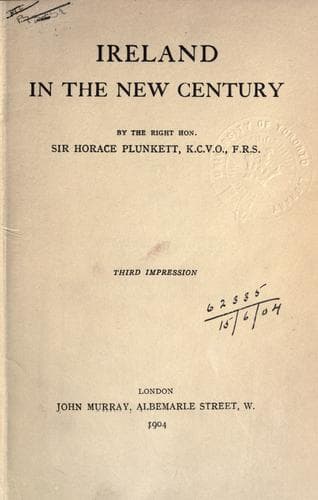
Ireland In The New CenturyPlunkett, Horace Curzon, Sir
History
Ireland In The New Century
Plunkett, Horace Curzon, Sir
Ireland -- Economic conditions; Ireland -- Politics and government -- 1901-1910; Irish question
Public opinion in favour of the new proposals grew rapidly. Before the
end of the year (1896) a deputation, representing all the leading
agricultural and industrial interests of the country, waited upon the
Irish Government, in order to press upon them the urgent need for the
new department. The Lord Lieutenant, after describing the gathering as
'one of the most notable deputations which had ever come to lay its case
before the Irish Government,' and noting the 'remarkable growth of
public opinion' in favour of the policy they were advocating, expressed
his heartfelt sympathy with the case which had been presented, and his
earnest desire--which was well known--to proceed with legislation for
the agricultural and industrial development of the country at the
earliest moment. The demand made upon the Government was,
argumentatively, already irresistible. But economic agitation of this
kind takes time to acquire dynamic force. Mr. Gerald Balfour introduced
a Bill the following year, but it had to be withdrawn to leave the way
clear for the other great Irish measure which revolutionised local
government. The unconventional agitation went on upon the original
lines, appealing to that latent public opinion which we were striving to
develop. In 1899 another Bill was introduced, and, owing to its masterly
handling by the Chief Secretary in the House of Commons, ably seconded
by the strong support given by Lord Cadogan, who was in the Cabinet, it
became law.
I cannot conclude this chapter without a word upon the extraordinary
misunderstanding of Mr. Gerald Balfour's policy to which the obscuring
atmosphere surrounding all Irish questions gave rise. In one respect
that policy was a new departure of the utmost importance. He proved
himself ready to take a measure from Ireland and carry it through,
instead of insisting upon a purely English scheme which he could call
his own. These pre-digested foods had already done much to destroy our
political digestion, and it was time we were given something to grow, to
cook, and to assimilate for ourselves. It will be seen, too, in the next
chapter, that he had realised the potentiality for good of the new
forces in Irish life to which he gave play in his two great linked
Acts--one of them popularising local government, and the other creating
a new Department which was to bring the government and the people
together in an attempt to develop the resources of the country. Yet his
eminently sane and far-seeing policy was regarded in many quarters as a
sacrifice of Unionist interests in Ireland. Its real effect was to endow
Unionism with a positive as well as a negative policy. But all reformers
know that the further ahead they look, the longer they have to wait for
their justification. Meanwhile, we may leave out of consideration the
division of honour or of blame for what has been done. The only matter
of historic interest is to arrive at a correct measure of the progress
made.
Public-domain text, read in full here on John Shaqi.
Reviews
Reviews
No reviews yet
Be the first to share your thoughts on this work.
Elsewhere in the archive
Join the Discussion
Join the discussion
Sign in to leave a comment or review.
Sign InorCreate an account