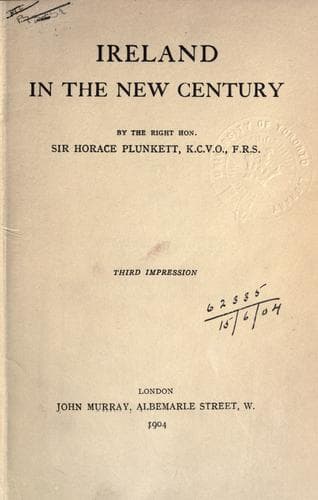
Ireland In The New CenturyPlunkett, Horace Curzon, Sir
History
Ireland In The New Century
Plunkett, Horace Curzon, Sir
Ireland -- Economic conditions; Ireland -- Politics and government -- 1901-1910; Irish question
The new movement had thus completed the first and second stages of its
mission. The idea of self-help had become a growing reality, and upon
this foundation an edifice of State aid had been erected. When a
Nationalist member met a Tory member of the Recess Committee he laughed
over the success with which they had wheedled a measure of industrial
Home Rule out of a Unionist Government. None the less they cordially
agreed that the people would rise to their economic responsibility. The
promoters of the movement had faith that this new departure in English
government would be more than justified by the English test, and that in
the new sphere of administration the government would be accorded,
without prejudice, of course, to the ultimate views either of Unionists
or Home Rulers, not only the consent, but the whole-hearted co-operation
of the governed.
FOOTNOTES:
[43] The memorandum which he kindly contributed to the Recess Committee
was copied into the Annual Report of the United States Department of
Agriculture for 1896.
CHAPTER IX.
A NEW DEPARTURE IN IRISH ADMINISTRATION.
To the average English Member of Parliament, the passing of an Act "for
establishing a Department of Agriculture and other Industries and
Technical Instruction in Ireland and for other purposes connected
therewith," probably signified little more than the removal of another
Irish grievance, which might not be imaginary, by the concession to
Ireland of an equivalent to the Board of Agriculture in England. In
reality the difference between the two institutions is as wide as the
difference between the two islands. The chief interest of the new
Department consists in the free play which it gives to the pent-up
forces of a re-awakening life. A new institution is at best but a new
opportunity, but the Department starts with the unique advantage that,
unlike most Irish institutions, it is one which we Irishmen planned
ourselves and for which we have worked. For this reason the opportunity
is one to which we may hope to rise.
Before I can convey any clear impression of the part which the
Department is, I believe, destined to play on the stage of Irish public
life, it will be necessary for me to give a somewhat detailed
description of its functions and constitution. The subject is perhaps
dull and technical; but readers cannot understand the Ireland of to-day
unless they have in their minds not only an accurate conception of the
new moral forces in Irish life and of the movements to which these
forces have given rise, but also a knowledge of the administrative
machinery and methods by which the people and the Government are now,
for the first time since the Union, working together towards the
building up of the Ireland of to-morrow.
Public-domain text, read in full here on John Shaqi.
Reviews
Reviews
No reviews yet
Be the first to share your thoughts on this work.
Elsewhere in the archive
Join the Discussion
Join the discussion
Sign in to leave a comment or review.
Sign InorCreate an account