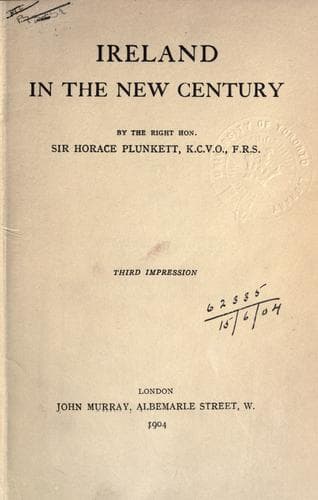
Ireland In The New CenturyPlunkett, Horace Curzon, Sir
History
Ireland In The New Century
Plunkett, Horace Curzon, Sir
Ireland -- Economic conditions; Ireland -- Politics and government -- 1901-1910; Irish question
(e.) One person to be appointed by the Board of Technical
Instruction.
Now the real value of this clause, and in this I think it shows a
consumate statesmanship, lies not in what it says, but in what it
suggests. The Committee, it will be observed, has an immensely important
function, but no power beyond such authority as its representative
character may afford. Any attempt to deal with a large educational
problem by a clause in a measure of this kind would have alarmed the
whole force of unco-ordinated pedagogy, and perhaps have wrecked the
Bill. The clause as it stands is in harmony with the whole spirit of the
new movement and of the legislation provided for its advancement. The
Committee may be very useful in suggesting improvements in educational
administration which will prevent unnecessary overlapping and lead to
co-operation between the systems concerned. Indeed it has already made
suggestions of far-reaching importance, which have been acted upon by
the educational authorities represented upon it. As I have said in an
earlier chapter when discussing Irish education from the practical
point of view, I have great faith in the efficacy of the economic factor
in educational controversy, and this Committee is certainly in a
position to watch and pronounce on any defects in our educational system
which the new efforts to deal practically with our industrial and
commercial problems may disclose.
There remains to be explained only one feature of the new administrative
machinery, and it is a very important one. The Recess Committee had
recommended the adaptation to Ireland of a type of central institution
which it had found in successful operation on the Continent wherever it
had pursued its investigations. So far as schemes applicable to the
whole country were concerned, the central Department, assuming that it
gained the confidence of the Council and Boards, might easily justify
its existence. But the greater part of its work, the Recess Committee
saw, would relate to special localities, and could not succeed without
the cordial co-operation of the people immediately concerned. This fact
brought Mr. Gerald Balfour face to face with a problem which the Recess
Committee could not solve in its day, because, when it sat, there still
existed the old grand jury system, though its early abolition had been
promised. It was extremely fortunate that to the same minister fell the
task of framing both the Act of 1898, which revolutionised local
government, and the Act of 1899, now under review. The success with
which these two Acts were linked together by the provisions of the
latter forms an interesting lesson in constructive statesmanship. Time
will, I believe, thoroughly discredit the hostile criticism which
withheld its due mead of praise from the most fruitful policy which any
administration had up to that time ever devised for the better
government of Ireland.
Public-domain text, read in full here on John Shaqi.
Reviews
Reviews
No reviews yet
Be the first to share your thoughts on this work.
Elsewhere in the archive
Join the Discussion
Join the discussion
Sign in to leave a comment or review.
Sign InorCreate an account