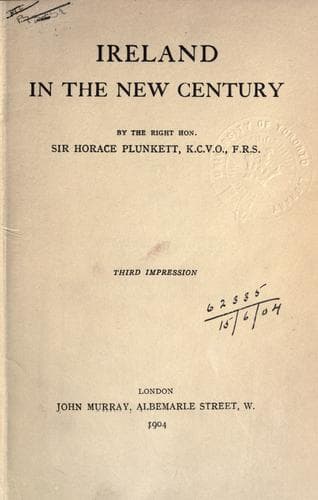
Ireland In The New CenturyPlunkett, Horace Curzon, Sir
History
Ireland In The New Century
Plunkett, Horace Curzon, Sir
Ireland -- Economic conditions; Ireland -- Politics and government -- 1901-1910; Irish question
If I have fairly stated the attitude towards each other of the workers
to whose coming together must be attributed as much of the change in the
Irish situation as is due to Irish initiation, it will be seen that what
had so long kept them apart in public affairs, outside politics, was a
difference of opinion, not so much as to the conditions to be dealt
with, nor, indeed, as to the end to be sought, but rather as to the
means most effective for the attainment of that end. I naturally regard
the view which I am putting forward as being broader than that which has
hitherto prevailed. Some Nationalists may, however, contend that it is
essential to progress that the thoughts and energies of the nation
should be focussed upon a single movement, and not dissipated in the
pursuit of a multiplicity of ideals. I quite admit the importance of
concentration. But I strongly hold that any movement which is closely
related to the main currents of the people's life and subservient to
their urgent economic necessities, and which gives free play to the
intellectual qualities, while strengthening the moral or industrial
character, cannot be held to conflict with any national programme of
work, without raising a strong presumption that there is something wrong
with the programme. The exclusively political remedy I shall discuss in
the next chapter, but here I propose to consider some of the problems
which the new movement seeks to solve without waiting for the political
millenium.
It is a commonplace that there are two Irelands, differing in race, in
creed, in political aspiration, and in what I regard as a more potent
factor than all the others put together--economic interest and
industrial pursuit. In the mutual misunderstanding of these two
Irelands, still more than in the misunderstanding of Ireland by England,
is to be found the chief cause of the still unsettled state of the Irish
Question. I shall not seek to apportion the blame between the two
sections of the population; but as the mists clear away and we can begin
to construct a united and contented Ireland, it is not only legitimate,
but helpful in the extreme, to assign to the two sections of our
wealth-producers their respective parts in repairing the fortunes of
their country. In such a discussion of future developments chief
prominence must necessarily be given to the problems affecting the life
of the majority of the people, who depend directly on the land, and
conduct the industry which produces by far the greater portion of the
wealth of the country. It is, of course, essential to the prosperity of
the whole community that the North should pursue and further develop
its own industrial and commercial life. That section of the community
has also, no doubt, economic and educational problems to face, but these
are much the same problems as those of industrial communities in other
parts of the United Kingdom[4]; and if they do not receive, vitally
Public-domain text, read in full here on John Shaqi.
Reviews
Reviews
No reviews yet
Be the first to share your thoughts on this work.
Join the Discussion
Join the discussion
Sign in to leave a comment or review.
Sign InorCreate an account