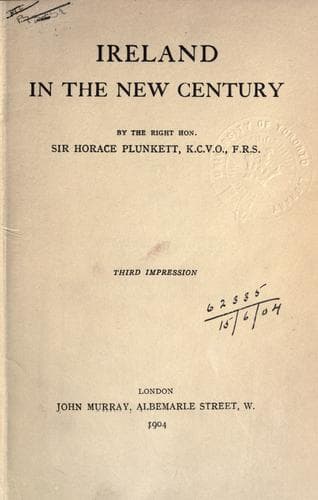
Ireland In The New CenturyPlunkett, Horace Curzon, Sir
History
Ireland In The New Century
Plunkett, Horace Curzon, Sir
Ireland -- Economic conditions; Ireland -- Politics and government -- 1901-1910; Irish question
Under the Land Act of 1903 much has been done to facilitate the transfer
of peasants to new farms, but it is obvious that land cannot be handed
over as a gift from the State to the families which migrate. They will
become debtors for the value of the land itself, less perhaps a small
sum which may be credited to them in respect of the tenant's interest in
the holdings they have abandoned. This deduction will, however, be lost
in the expenditure required upon houses, buildings, fences, and other
improvements which would have to be effected before the land could be
profitably occupied. Speaking generally they will have no money or
agricultural implements, and their live stock will in many cases be
mortgaged to the local shopkeeper who has always financed them. It will
be necessary for the future welfare of the country to give them land
which admits of cultivation upon the ordinary principles of modern
agriculture; but without working capital, and bringing with them neither
the skill nor the habits necessary for the successful conduct of their
industry under the new conditions, it will be no easy task to place them
in a position to discharge their obligations to the State. It is all
very easy to talk about the obvious necessity of giving more land to
cultivators who have not enough to live upon; and there is, no doubt, a
poetic justice in the Utopian agrarianism which dangles before the eyes
of the Connaught peasantry the alternative of Heaven or Leinster. But
when we come down to practical economics, and face the task of giving to
a certain number of human beings, in an extremely backward industrial
condition, the opportunity of placing themselves and their families on a
basis of permanent well-being, it will be evident that, so far, at any
rate, as this particular community is concerned, the mere provision of
an economic holding is after all but a part of an economic existence.
I have touched upon this question of migration from uneconomic to
economic holdings because it signally illustrates the importance of the
human, in contradistinction to the merely material considerations
involved in the solution of the many-sided Irish Question. I must now
return to the wider question of the relation of population to area in
rural Ireland, as it affects the general scheme of agricultural and
industrial development.
Public-domain text, read in full here on John Shaqi.
Reviews
Reviews
No reviews yet
Be the first to share your thoughts on this work.
Join the Discussion
Join the discussion
Sign in to leave a comment or review.
Sign InorCreate an account