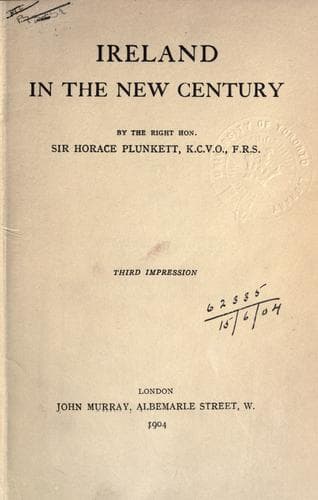
Ireland In The New CenturyPlunkett, Horace Curzon, Sir
History
Ireland In The New Century
Plunkett, Horace Curzon, Sir
Ireland -- Economic conditions; Ireland -- Politics and government -- 1901-1910; Irish question
To a sympathetic insight there is a singular and significant void in the
Irish conception of a home--I mean the lack of appreciation for the
comforts of a home, which might never have been apparent to me had it
not obtruded itself in the form of a hindrance to social and economic
progress.[9] In the Irish love of home, as in the larger national
aspirations, the ideal has but a meagre material basis, its appeal being
essentially to the social and intellectual instincts. It is not the
physical environment and comfort of an orderly home that enchain and
attract minds still dominated, more or less unconsciously, by the
associations and common interests of the primitive clan, but rather the
sense of human neighbourhood and kinship which the individual finds in
the community. Indeed the Irish peasant scarcely seems to have a home in
the sense in which an Englishman understands the word. If he love the
place of his habitation he does not endeavour to improve or to adorn it,
or indeed to make it in any sense a reflection of his own mind and
taste. He treats life as if he were a mere sojourner upon earth whose
true home is somewhere else, a fact often attributed to his intense
faith in the unseen, but which I regard as not merely due to this cause,
but also, and in a large measure, as the natural outcome of historical
conditions, to which I shall presently refer.
What the Irishman is really attached to in Ireland is not a home but a
social order. The pleasant amenities, the courtesies, the leisureliness,
the associations of religion, and the familiar faces of the neighbours,
whose ways and minds are like his and very unlike those of any other
people; these are the things to which he clings in Ireland and which he
remembers in exile. And the rawness and eagerness of America, the lust
of the eye and the pride of life that meet him, though with no welcoming
aspect, at every turn, the sense of being harshly appraised by new
standards of the nature of which he has but the dimmest conception, his
helplessness in the fierce current of industrial life in which he is
plunged, the climatic extremes of heat and cold, the early hours and few
holidays: all these experiences act as a rude shock upon the
ill-balanced refinement of the Irish immigrant. Not seldom, he or she
loses heart and hope and returns to Ireland mentally and physically a
wreck, a sad disillusionment to those who had been comforted in the
agony of the leave-taking by the assurance that to emigrate was to
succeed.
Public-domain text, read in full here on John Shaqi.
Reviews
Reviews
No reviews yet
Be the first to share your thoughts on this work.
Join the Discussion
Join the discussion
Sign in to leave a comment or review.
Sign InorCreate an account