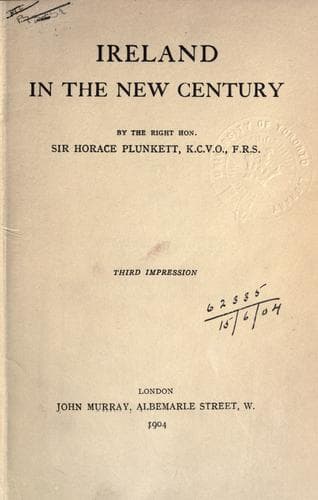
Ireland In The New CenturyPlunkett, Horace Curzon, Sir
History
Ireland In The New Century
Plunkett, Horace Curzon, Sir
Ireland -- Economic conditions; Ireland -- Politics and government -- 1901-1910; Irish question
In such an examination of Irish politics as thus becomes necessary I
shall have to devote the greater part of my criticism to the influence
of the Nationalist party upon the Irish mind. But it will be seen that
this course is not taken with a view to making party capital for my own
side. As I read Irish history, neither party need expect very much
credit for more than good intentions. Whichever proves to be right in
its main contention, each will have to bear its share of the
responsibility for the long continuance of the barren controversy. Each
has neglected to concern itself with the settlement of vitally important
questions the consideration of which need not have been postponed
because the constitutional question still remained in dispute.
Therefore, though I seem to throw upon the Nationalist party the chief
blame for our present political backwardness, and, so far as politics
affect other spheres of national activity, for our industrial
depression, candour compels me to admit that Irish Unionism has failed
to recognise its obligation--an obligation recognised by the Unionist
party in Great Britain--to supplement opposition to Home Rule with a
positive and progressive policy which could have been expected to
commend itself to the majority of the Irish people--the Irish of the
Irish Question.
To my own party in Ireland then, I would first direct the reader's
attention. I have already referred to the deplorable effects produced
upon national life by the exclusion of representatives of the landlord
and the industrial classes from positions of leadership and trust over
four-fifths of the country. I cannot conceive of a prosperous Ireland in
which the influence of these leaders is restricted within its present
bounds. It has been so restricted because the Irish Unionist party has
failed to produce a policy which could attract, at any rate, moderate
men from the other side, and we have, therefore, to consider why we have
so failed. Until this is done, we shall continue to share the blame for
the miserable state of our political life which, at the end of the
nineteenth century, appeared to have made but little advance from the
time when Bishop Berkeley asked 'Whether our parties are not a burlesque
upon politics.'
Public-domain text, read in full here on John Shaqi.
Reviews
Reviews
No reviews yet
Be the first to share your thoughts on this work.
Join the Discussion
Join the discussion
Sign in to leave a comment or review.
Sign InorCreate an account