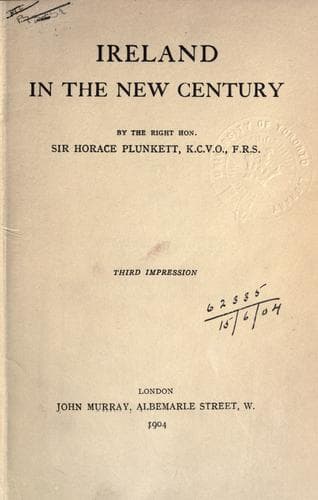
Ireland In The New CenturyPlunkett, Horace Curzon, Sir
History
Ireland In The New Century
Plunkett, Horace Curzon, Sir
Ireland -- Economic conditions; Ireland -- Politics and government -- 1901-1910; Irish question
I am aware that any political deficiencies which the Irish may display
at home, are commonly attributed to the political system which has been
imposed upon Ireland from without. If you want to see Irish genius in
its highest political manifestation, it must be studied, we are told, in
the United States, the widest and freest arena which has ever been
offered to the race. This view is not in accordance with the facts as I
have observed them. These facts are somewhat obscured by the natural,
but misleading habit of reckoning to the account of Ireland at large
achievements really due to the Scotch-Irish, who helped to colonise
Pennsylvania, and who undoubtedly played a dominant part in developing
the characteristic features of the American political system. The
Scotch-Irish, however, do not belong to the Ireland of the Irish
Question Descended, largely, as their names so often testify, from the
early Irish colonists of western Scotland, they came back as a distinct
race, dissociating themselves from the Irish Celts by refusing to adopt
their national traditions, or intermarry with them, and both here and in
America disclaiming the appellation of Irish.[12]
Leaving, then, out of consideration the political achievements of the
Scotch-Irish, it appears to me that the part played in politics by the
Irish in America does not testify to any high political genius. They
have shown there an extraordinary aptitude for political organisation,
which, if it had been guided by anything approaching to political
thought, would have placed them in a far higher position in American
public life than that which they now occupy. But the fact is that it
would be much easier to find evidence of high political capacity and
success in the history of the Irish in British colonies; and the reason
for this fact is not only very germane to the purpose of this book, but
has a strong practical interest for Americans as well. Irishmen when
they go to America find themselves united by a bond which does not and
could not exist in the Colonies--though it does exist in Ireland--the
bond of anti-English feeling, and by the hope of giving practical effect
to this feeling through the policy of their adopted country. Imbued with
this common sentiment, and influenced by their inherited clannishness,
the Irish in America readily lend themselves to the system of political
groups, a system which the 'boss' for his own ends seeks to perpetuate.
The result is a sort of political paradox--it has made the Irish in
America both stronger and weaker than they ought to be. They suffer
politically from the defects of their political qualities: they are
strong as a voting machine, but the secret of their collective strength
is also the secret of their individual weakness. This organisation into
groups is much commoner among the Irish than among other American
immigrants, for the anti-English feeling with which so many of the Irish
Public-domain text, read in full here on John Shaqi.
Reviews
Reviews
No reviews yet
Be the first to share your thoughts on this work.
Join the Discussion
Join the discussion
Sign in to leave a comment or review.
Sign InorCreate an account