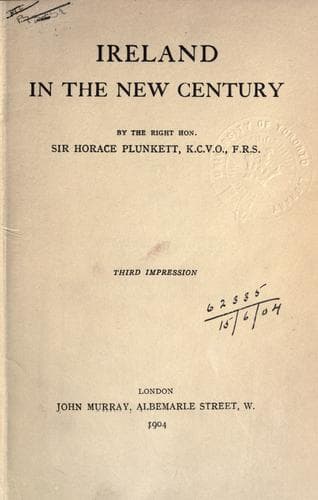
Ireland In The New CenturyPlunkett, Horace Curzon, Sir
History
Ireland In The New Century
Plunkett, Horace Curzon, Sir
Ireland -- Economic conditions; Ireland -- Politics and government -- 1901-1910; Irish question
Although the nineteenth century, with all its marvellous contributions
to human progress, left Ireland with her hopes unfulfilled; although its
sun went down upon the British people with their greatest failure still
staring them in the face, its last decade witnessed at first a change in
the attitude of England towards Ireland, and afterwards a profound
revolution in the thoughts of Ireland about herself. The strangest and
most interesting feature of these developments was that in practical
England the Irish Question became the great political issue, while in
sentimental Ireland there set in a reaction from politics and an
inclination to the practical. The twentieth century has already brought
to birth the new Ireland upon whose problems I shall write. If the human
interest of these problems is to be realized, if their significance is
not to be as wholly misunderstood as that of every other Irish movement
which has perplexed the statesmen who have managed our affairs, they
must be studied in their relation to the English and Irish events of the
period in which the new Ireland was conceived.
In 1885 Gladstone, appealing to an electorate with a large accession of
newly enfranchised voters, transferred the struggle over the Irish
Question from Ireland to Great Britain. The position taken up by the
average English Home Ruler was, it will be remembered, simple and
intelligible. The Irish had stated in the proper constitutional way what
they wanted, and that, in the first flush of a victorious democracy,
when counting heads irrespective of contents was the popular method of
arriving at political truth, was assumed to be precisely what they ought
to have. A long but inconclusive contest ensued. At times it looked as
if the Liberal-Irish alliance might snatch a victory for their policy.
But when Gladstone was forced to break with the Irish Leader, and
Parnellism without Parnell became obviously impossible, the English
realised that the working of representative institutions in Ireland had
produced not a democracy but a dictatorship, and they began to attach a
lesser significance to the verdict of the Irish polls. Their faith in
democracy was unimpaired, but, in their opinion, the Irish had not yet
risen to its dignity. So most English Radicals came round to a view
which they had always reprobated when advanced by the English
Conservatives, and political inferiority was added to the other moral
and intellectual defects which made the Irish an inferior race!
Public-domain text, read in full here on John Shaqi.
Reviews
Reviews
No reviews yet
Be the first to share your thoughts on this work.
Join the Discussion
Join the discussion
Sign in to leave a comment or review.
Sign InorCreate an account