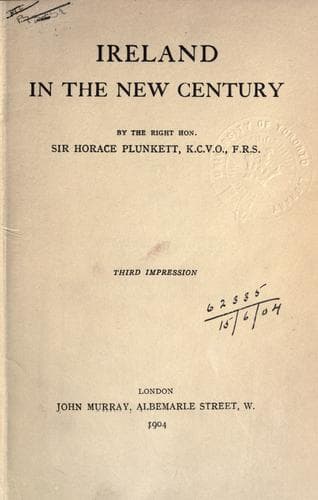
Ireland In The New CenturyPlunkett, Horace Curzon, Sir
History
Ireland In The New Century
Plunkett, Horace Curzon, Sir
Ireland -- Economic conditions; Ireland -- Politics and government -- 1901-1910; Irish question
[21] This view seems to be taken by the most influential spokesmen of
the Roman Catholic Hierarchy. See Evidence, _Royal Commission on
University Education in Ireland_, vol. iii., p. 238, Questions 8702-6.
[22] I may mention that of the co-operative societies organised by the
Irish Agricultural Organisation Society there are no fewer than 331
societies of which the local priests are the Chairmen, while to my own
knowledge during the summer and autumn of 1902, as many as 50,000
persons from all parts of Ireland were personally conducted over the
exhibit of the Department of Agriculture and Technical Instruction at
the Cork Exhibition by their local clergy. The educational purpose of
these visits is explained in Chap. x. Again, in a great number of cases
the village libraries which have been recently started in Ireland with
the assistance of the Department (the books consisting largely of
industrial, economic, and technical works on agriculture), have been
organised and assisted by the Roman Catholic clergy.
CHAPTER V.
A PRACTICAL VIEW OF IRISH EDUCATION.
A little learning, we are told, is a dangerous thing; and in their
dealings with Irish education the English should have discovered that
this danger is accentuated when the little learning is combined with
much native wit. In the days when religious persecution was
universal--only, be it remembered, a few generations ago--it was the
policy of England to avert this danger by prohibiting, as far as
possible, the acquisition by Irish Roman Catholics of any learning at
all. After the Union, Englishmen began to feel their responsibility for
the state of Ireland, a state of poverty and distress which culminated
in the Famine. Knowledge was then no longer withheld: indeed the English
sincerely desired to dispel our darkness and enable us to share in the
wisdom, and so in the prosperity, of the predominant partner. In their
attempts to educate us they dealt with what they saw on the surface, and
moulded their educational principles upon what they knew; but they did
not know Ireland. Even if we excuse them for paying scant attention to
what they were told by Irishmen, they should have given more heed to the
reports of their own Royal Commissions.
We have so far seen that the Irish mind has been in regard to
economics, politics, and even some phases of religious influence, a mind
warped and diseased, deprived of good nutrition and fed on fancies or
fictions, out of which no genuine growth, industrial or other, was
possible. The one thing that might have strengthened and saved a people
with such a political, social, and religious history, and such racial
characteristics, was an educational system which would have had special
regard to that history, and which would have been a just expression of
the better mind of the people whom it was intended to serve.
Public-domain text, read in full here on John Shaqi.
Reviews
Reviews
No reviews yet
Be the first to share your thoughts on this work.
Elsewhere in the archive
Join the Discussion
Join the discussion
Sign in to leave a comment or review.
Sign InorCreate an account