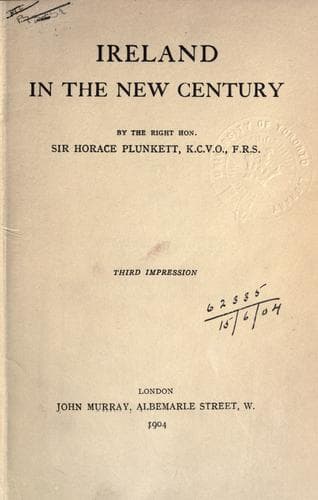
Ireland In The New CenturyPlunkett, Horace Curzon, Sir
History
Ireland In The New Century
Plunkett, Horace Curzon, Sir
Ireland -- Economic conditions; Ireland -- Politics and government -- 1901-1910; Irish question
Now this is exactly what was denied to Ireland. Not merely has all
educational legislation come from England, in the sense of being based
on English models and thought out by Englishmen largely out of touch and
sympathy with the peculiar needs of Ireland, but whenever there has been
genuine native thought on Irish educational problems, it has been either
ignored altogether or distorted till its value and significance were
lost. And in this matter we can claim for Ireland that there was in the
country during the first half of the nineteenth century, when England
was trying her best to provide us with a sound English education, a
comparatively advanced stage of home-grown Irish thought upon the
educational needs of the people. Take, for example, the Society for
Promoting Elementary Education among the Irish Poor, know as the Kildare
Street Society, which was founded as early as the year 1811. The first
resolution passed by this body, which was composed of prominent Dublin
citizens of all religious beliefs, was set out as follows:--
(1.) Resolved--That promoting the education of the poor of Ireland
is a grand object which every Irishman anxious for the welfare and
prosperity of his country ought to have in view as the basis upon
which the morals and true happiness of the country can be best
secured.
This Society, it is true, did not see or foresee that any system of
mixed religious education was doomed to failure in Ireland, but they
took a wide view of the place of education in a nation's development,
and the character of the education which their schools actually
dispensed was admirable. This hopeful and enterprising educational
movement is described by Mr. Lecky in a passage from which I take a few
extracts:--
Public-domain text, read in full here on John Shaqi.
Reviews
Reviews
No reviews yet
Be the first to share your thoughts on this work.
Elsewhere in the archive
Join the Discussion
Join the discussion
Sign in to leave a comment or review.
Sign InorCreate an account