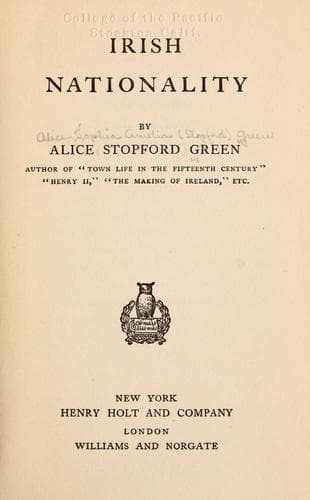
Ireland -- History; Ireland -- Politics and government; Irish question
For thirty-four years Columcille ruled as abbot in Iona, the high
leader of the Celtic world. He watched the wooden ships with great
sails that crossed from shore to shore; he talked with mariners
sailing south from the Orkneys, and others coming north from the Loire
with their tuns of wine, who told him European tidings, and how a
town in Istria had been wrecked by earthquake. His large
statesmanship, his lofty genius, the passionate and poetic temperament
that filled men with awe and reverence, the splendid voice and stately
figure that seemed almost miraculous gifts, the power of inspiring
love that brought dying men to see his face once more before they fell
at his feet in death, give a surpassing dignity and beauty to his
life. "He could never spend the space of even one hour without study
or prayer or writing, or some other holy occupation ... and still in
all these he was beloved by all." "Seasons and storms he perceived, he
harmonised the moon's race with the branching sun, he was skilful in
the course of the sea, he would count the stars of heaven." He
desired, one of his poems tells us, "to search all the books that
would be good for any soul"; and with his own hand he copied, it is
said, three hundred books, sitting with open cell door, where the
brethren, one with his butcher's knife, one with his milk pail,
stopped to ask a blessing as they passed.
After his death the Irish monks carried his work over the whole of
England. A heathen land lay before them, for the Roman missionaries
established in 597 by Augustine in Canterbury, speaking no English and
hating "barbarism," made little progress, and after some reverses were
practically confined to Kent. The first cross of the English
borderland was set up in 635 by men from Iona on a heather moorland
called the Heaven-field, by the ramparts of the Roman Wall. Columban
monks made a second Iona at Lindisfarne, with its church of hewn oak
thatched with reeds after Irish tradition in sign of poverty and
lowliness, and with its famous school of art and learning. They taught
the English writing, and gave them the letters which were used among
them till the Norman Conquest. Labour and learning went hand in hand.
From the king's court nobles came, rejoicing to change the brutalities
of war for the plough, the forge-hammer, the winnowing fan: waste
places were reclaimed, the ports were crowded with boats, and
monasteries gave shelter to travellers. For a hundred years wherever
the monks of Iona passed men ran to be signed by their hand and
blessed by their voice. Their missionaries wandered on foot over
middle England and along the eastern coast and even touched the
Channel in Sussex. In 662 there was only one bishop in the whole of
England who was not of Irish consecration, and this bishop, Agilberct
of Wessex, was a Frenchman who had been trained for years in Ireland.
The great school of Malmesbury in Wessex was founded by an Irishman,
as that of Lindisfarne had been in the north.
Public-domain text, read in full here on John Shaqi.
Reviews
Reviews
No reviews yet
Be the first to share your thoughts on this work.
Join the Discussion
Join the discussion
Sign in to leave a comment or review.
Sign InorCreate an account