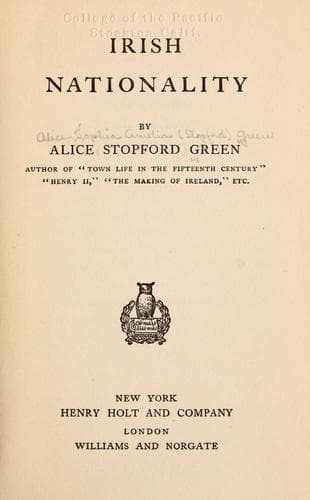
Ireland -- History; Ireland -- Politics and government; Irish question
The uplifting of the national ideal was shown in the fourteenth and
fifteenth centuries by a revival of learning like that which followed
the Danish wars. Not one of the hereditary houses of historians,
lawyers, poets, physicians, seems to have failed: we find them at work
in the mountains of Donegal, along the Shannon, in lake islands,
among the bare rocks of Clare, in the plains of Meath, in the valleys
of Munster. In astronomy Irishmen were still first in Europe. In
medicine they had all the science of their age. Nearly all our
knowledge of Irish literature comes from copies of older works made by
hundreds of industrious scribes of this period. From time to time
Assemblies of all the learned men were called together by patriotic
chiefs, or by kings rising into high leadership--"coming to Tara," as
the people said. The old order was maintained in these national
festivals. Spacious avenues of white houses were made ready for poets,
streets of peaked hostels for musicians, straight roads of smooth
conical-roofed houses for chroniclers, another avenue for bards and
jugglers, and so on; and on the bright surface of the pleasant hills
sleeping-booths of woven branches for the companies. From sea to sea
scholars and artists gathered to show their skill to the men of
Ireland; and in these glorious assemblies the people learned anew the
wealth of their civilisation, and celebrated with fresh ardour the
unity of the Irish nation.
It was no wonder that in this high fervour of the country the
Anglo-Normans, like the Danes and the Northumbrians before them, were
won to a civilisation so vital and impassioned, so human and gay. But
the mixed civilisation found no favour with the government; the "wild
Irish" and the "degenerate English" were no better than "brute
beasts," the English said, abandoned to "filthy customs" and to "a
damnable law that was no law, hateful to God and man." Every measure
was taken to destroy the growing amity of the peoples, not only by
embroiling them in war, but by making union of Ireland impossible in
religion or in education, and by destroying public confidence. The new
central organisation of the Irish church made it a powerful weapon in
English hands. An Englishman was at once put in every archbishopric
and every principal see, a prelate who was often a Castle official as
well, deputy, chancellor, justice, treasurer, or the like, or a good
soldier--in any case hostile to every Irish affection. A national
church in the old Irish sense disappeared; in the English idea the
church was to destroy the nation. Higher education was also denied to
both races. No Irish university could live under the eye of an English
primate of Armagh, and every attempt of Anglo-Normans to set up a
university for Ireland at Dublin or Drogheda was instantly crushed. To
avert general confidence and mutual understanding, an alien class was
maintained in the country, who for considerations of wealth, power, a
Public-domain text, read in full here on John Shaqi.
Reviews
Reviews
No reviews yet
Be the first to share your thoughts on this work.
Join the Discussion
Join the discussion
Sign in to leave a comment or review.
Sign InorCreate an account