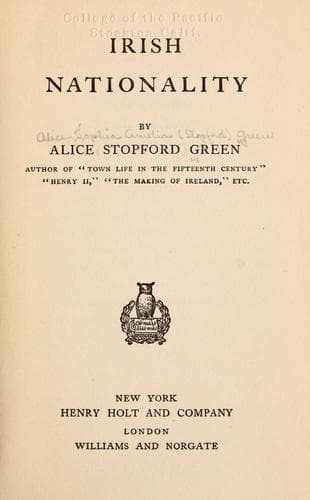
Ireland -- History; Ireland -- Politics and government; Irish question
Henry VIII, like Henry II, was not concerned to give "civilisation" to
Ireland. He was concerned to take the land. His reasons were the same.
If he possessed the soil in his own right, apart from the English
parliament, and commanded its fighting-men and its wealth, he could
beat down rebellion in England, smite Scotland into obedience, conquer
France, and create an empire of bounds unknown--and in time of danger
where so sure a shelter for a flying sovereign? Claims were again
revived to "our rightful inheritance"; quibbles of law once more
served for the king's "title to the land"; there was another great day
of deception in Dublin. Henry asked the title of King of Ireland
instead of Lord, and offered to the chiefs in return full security for
their lands. For months of subtle preparation his promises were
explicit. All cause of offence was carefully taken away. Finally a
parliament was summoned (1541) of lords carefully bribed and commons
carefully packed--the very pattern, in fact, of that which was later
called to vote the Union. And while they were by order voting the
title, the king and council were making arrangements together to
render void both sides of the bargain. First the wording of the title
was so altered as to take away any value in the "common consent" of
parliament, since the king asserted his title to Ireland by
inheritance and conquest, before and beyond all mandate of the popular
will. And secondly it was arranged that Henry was under no obligation
by negotiations or promises as to the land. For since, by the
council's assurance to the king on the day the title was passed, there
was no land occupied by any "disobedient" people which was not really
the king's property by ancient inheritance or by confiscation, Henry
might do as he would with his own. Royal concessions too must depend
on how much revenue could be extracted from them to keep up suitably
the title of king--on whether it was judicious to give Irishmen titles
which they might afterwards plead to be valid--on whether Henry would
find the promised grants convenient in case he chose later to proceed
to "conquest and extermination."
Public-domain text, read in full here on John Shaqi.
Reviews
Reviews
No reviews yet
Be the first to share your thoughts on this work.
Join the Discussion
Join the discussion
Sign in to leave a comment or review.
Sign InorCreate an account