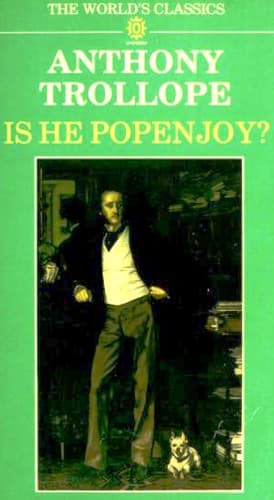
Domestic fiction; Inheritance and succession -- Fiction
The story which I have to tell is something in its nature akin to that
of poor Mrs. Jones, who was happy enough down in Devonshire till that
wicked Lieutenant Smith came and persecuted her; not quite so tragic,
perhaps, as it is stained neither by murder nor madness. But before I
can hope to interest readers in the perplexed details of the life of a
not unworthy lady, I must do more than remind them that they do know,
or might have known, or should have known the antecedents of my
personages. I must let them understand how it came to pass that so
pretty, so pert, so gay, so good a girl as Mary Lovelace, without any
great fault on her part, married a man so grim, so gaunt, so sombre,
and so old as Lord George Germain. It will not suffice to say that she
had done so. A hundred and twenty little incidents must be dribbled
into the reader's intelligence, many of them, let me hope, in such
manner that he shall himself be insensible to the process. But unless I
make each one of them understood and appreciated by my ingenious,
open-hearted, rapid reader,--by my reader who will always have his
fingers impatiently ready to turn the page,--he will, I know, begin to
masticate the real kernel of my story with infinite prejudices against
Mary Lovelace.
Mary Lovelace was born in a country parsonage; but at the age of
fourteen, when her life was in truth beginning, was transferred by her
father to the deanery of Brotherton. Dean Lovelace had been a fortunate
man in life. When a poor curate, a man of very humble origin, with none
of what we commonly call Church interest, with nothing to recommend him
but a handsome person, moderate education, and a quick intellect, he
had married a lady with a considerable fortune, whose family had bought
for him a living. Here he preached himself into fame. It is not at all
to be implied from this that he had not deserved the fame he acquired.
He had been active and resolute in his work, holding opinions which, if
not peculiar, were at any rate advanced, and never being afraid of the
opinions which he held. His bishop had not loved him, nor had he made
himself dear to the bench of bishops generally. He had the reputation
of having been in early life a sporting parson. He had written a book
which had been characterised as tending to infidelity, and had more
than once been invited to state dogmatically what was his own belief.
He had never quite done so, and had then been made a dean. Brotherton,
as all the world knows, is a most interesting little city, neither a
Manchester nor a Salisbury; full of architectural excellencies, given
to literature, and fond of hospitality. The Bishop of Brotherton,--who
did not love the dean,--was not a general favourite, being strict,
ascetic, and utterly hostile to all compromises. At first there were
certain hostile passages between him and the new dean. But the Dean,
who was and is urbanity itself, won the day, and soon became certainly
the most popular man in Brotherton.
Public-domain text, read in full here on John Shaqi.
Reviews
Reviews
No reviews yet
Be the first to share your thoughts on this work.
Join the Discussion
Join the discussion
Sign in to leave a comment or review.
Sign InorCreate an account