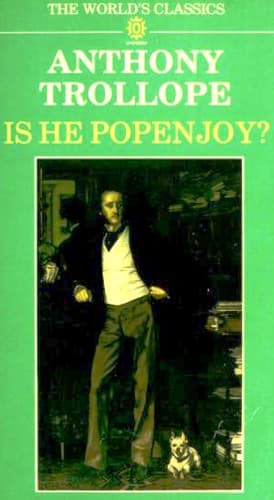
Domestic fiction; Inheritance and succession -- Fiction
In spite of her suffering, which must have been real, and her fainting,
which had partly been so, Mrs. Houghton had had force enough to tell
her husband that he would himself be inexpressibly bored by remaining
at Manor Cross, and that his presence would inexpressibly bore "all
those dowdy old women," as she called the ladies of the house.
"Besides, what's the use?" she said; "I've got to lay here for a
certain time. You would not be any good at nursing. You'd only kill
yourself with ennui. I shall do well enough, and do you go on with your
hunting." He had assented; but finding her to be well enough to express
her opinion as to the desirability of his absence strongly, thought
that she was well enough, also, to be rebuked for her late
disobedience. He began, therefore, to say a word. "Oh! Jeffrey, are you
going to scold me," she said, "while I am in such a state as this!" and
then, again, she almost fainted. He knew that he was being ill-treated,
but knowing, also, that he could not avoid it, he went away without a
further word.
But she was quite cheerful that evening when Lady George came up to
give her her dinner. She had begged that it might be so. She had known
"dear Mary" so long, and was so warmly attached to her. "Dear Mary" did
not dislike the occupation, which was soon found to comprise that of
being head nurse to the invalid. She had never especially loved
Adelaide De Baron, and had felt that there was something amiss in her
conversation when they had met at the deanery; but she was brighter
than the ladies at Manor Cross, was affectionate in her manner, and was
at any rate young. There was an antiquity about every thing at Manor
Cross, which was already crushing the spirit of the young bride.
"Dear me! this is nice," said Mrs. Houghton, disregarding, apparently
altogether, the pain of her shoulder; "I declare, I shall begin to be
glad of the accident!"
"You shouldn't say that."
"Why not, if I feel it? Doesn't it seem like a thing in a story that I
should be brought to Lord George's house, and that he was my lover only
quite the other day?" The idea had never occurred to Mary, and now that
it was suggested to her, she did not like it. "I wonder when he'll come
and see me. It would not make you jealous, I hope."
"Certainly not."
"No, indeed. I think he's quite as much in love with you as ever he was
with me. And yet, he was very, very fond of me once. Isn't it odd that
men should change so?"
"I suppose you are changed, too," said Mary,--hardly knowing what to
say.
"Well,--yes,--no. I don't know that I'm changed at all. I never told
Lord George that I loved him. And what's more, I never told Mr.
Houghton so. I don't pretend to be very virtuous, and of course I
married for an income. I like him very well, and I always mean to be
good to him; that is, if he lets me have my own way. I'm not going to
be scolded, and he need not think so."
"You oughtn't to have gone on to-day, ought you?"
Public-domain text, read in full here on John Shaqi.
Reviews
Reviews
No reviews yet
Be the first to share your thoughts on this work.
Join the Discussion
Join the discussion
Sign in to leave a comment or review.
Sign InorCreate an account