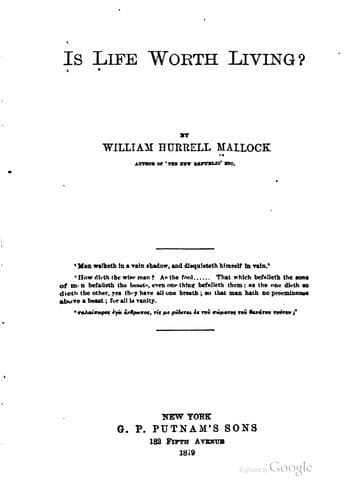
Is Life Worth Living?Mallock, W. H. (William Hurrell)
Philosophy
Is Life Worth Living?
Mallock, W. H. (William Hurrell)
Ethics; Life
Of these three sets of arguments, the two first bear upon all religion,
whilst the third bears upon it only as embodied in some exclusive form.
Thus the physicist argues, for example, that consciousness being a
function of the brain, unless the universe be a single brain itself,
there can be no conscious God.[33] The moral philosopher argues that sin
and misery being so prevalent, there can be no Almighty and all-merciful
God. And the historian argues that all alleged revelations can be shown
to have had analogous histories; and that therefore, even if God exists,
there is no one religion through which He has specially revealed
Himself. These are rough specimens solubly, _so far as observation can
carry us_, mind with matter. The great gulf between the two has at last
been spanned. The bridge across it, that was so long seen in dreams and
despaired of, has been thrown triumphantly--a solid compact fabric, on
which a hundred intellectual masons are still at work, adding stone on
ponderous stone to it. Science, to put the matter in other words, has
accomplished these three things. Firstly, to use the words of a
well-known writer, '_it has established a functional relation to exist
between every fact of thinking, willing, or feeling, on the one side,
and some molecular change in the body on the other side_.' Secondly, it
has connected, through countless elusive stages, this organic human body
with the universal lifeless matter. And thirdly, it claims to have
placed the universal matter itself in a new position for us, and to
exhibit all forms of life as developed from it, through its own
spontaneous motion. Thus for the first time, beyond the reach of
question, the entire sensible universe is brought within the scope of
the physicist. Everything that is, is matter moving. Life itself is
nothing but motion of an infinitely complex kind. It is matter in its
finest ferment. The first traceable beginnings of it are to be found in
the phenomenon of crystallisation; we have there, we are told by the
highest scientific authority, '_the first gropings of the so-called
vital force_;' and we learn from the same quarter, that between these
and the brain of Christ there is a difference in degree only, not in
kind: they are each of them '_an assemblage of molecules, acting and
re-acting according to law_.' '_We believe_,' says Dr. Tyndall, '_that
every thought and every feeling has its definite mechanical
correlative--that it is accompanied by a certain breaking up and
re-marshalling of the atoms of the brain_.' And though he of course
admits that to trace out the processes in detail is infinitely beyond
our powers, yet '_the quality of the problem and of our powers_,' he
says, '_are, we believe, so related, that a mere expansion of the latter
would enable them to cope with the former_.' Nowhere is there any break
in Nature; and '_supposing_,' in Dr. Tyndall's words, '_a planet carved
from the sun, set spinning on an axis, and sent revolving round the sun
Public-domain text, read in full here on John Shaqi.
Reviews
Reviews
No reviews yet
Be the first to share your thoughts on this work.
Elsewhere in the archive
Join the Discussion
Join the discussion
Sign in to leave a comment or review.
Sign InorCreate an account