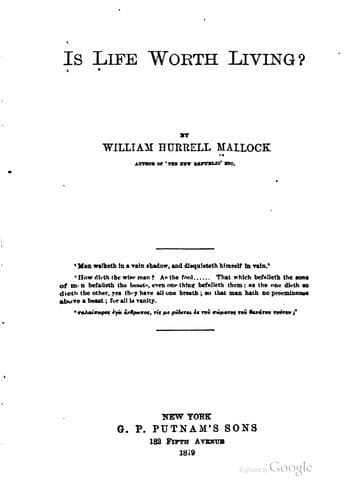
Is Life Worth Living?Mallock, W. H. (William Hurrell)
Philosophy
Is Life Worth Living?
Mallock, W. H. (William Hurrell)
Ethics; Life
at a distance equal to that of our earth_,' science points to the
conclusion that as the mass cooled, it would flower out in places into
just such another race as ours--creatures of as large discourse, and,
like ourselves, looking before and after. The result is obvious. Every
existing thing that we can ever know, or hope to know, in the whole
inward as well as in the whole outward world--everything from a star to
a thought, or from a flower to an affection, is connected with certain
material figures, and with certain mechanical forces. All have a certain
bulk and a certain place in space, and could conceivably be made the
subjects of some physical experiment. Faith, sanctity, doubt, sorrow,
and love, could conceivably be all gauged and detected by some
scientific instrument--by a camera or by a spectroscope; and their
conditions and their intensity be represented by some sort of diagram.
These marvellous achievements, as I have said, have been often before
dreamed of. Now they are accomplished. As applied to natural religion,
the effect of them is as follows.
Firstly, with regard to God, they have taken away every external proof
of His existence, and, still more, every sign of His daily providence.
They destroy them completely at a sudden and single blow, and send them
falling about us like so many dead flies. God, as connected with the
external world, was conceived of in three ways--as a Mover, as a
Designer, and as a Superintendent. In the first two capacities He was
required by thought; in the last, He was supposed to be revealed by
experience. But now in none of these is He required or revealed longer.
So far as thought goes, He has become a superfluity; so far as
experience goes, He has become a fanciful suggestion.
Secondly, with regard to man, the life and soul are presented to us, not
as an entity distinct from the body, and therefore capable of surviving
it, but as a function of it, or the sum of its functions, which has
demonstrably grown with its growth, which is demonstrably dependent upon
even its minutest changes, and which, for any sign or hint to the
contrary, will be dissolved with its dissolution.
Public-domain text, read in full here on John Shaqi.
Reviews
Reviews
No reviews yet
Be the first to share your thoughts on this work.
Elsewhere in the archive
Join the Discussion
Join the discussion
Sign in to leave a comment or review.
Sign InorCreate an account