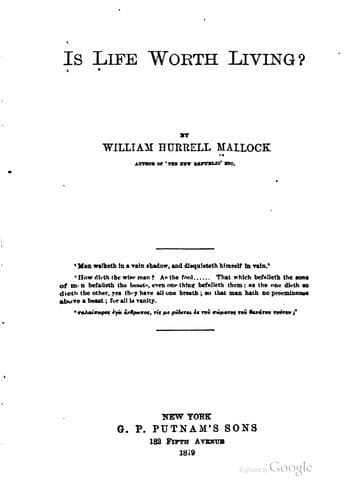
Is Life Worth Living?Mallock, W. H. (William Hurrell)
Philosophy
Is Life Worth Living?
Mallock, W. H. (William Hurrell)
Ethics; Life
A God, therefore, that is the master of matter, and a human soul that is
independent of it--any second world, in fact, of alien and
trans-material forces, is reduced, on physical grounds, to an utterly
unsupported hypothesis. Were this all, however, it would logically have
on religion no effect at all. It would supply us with nothing but the
barren verbal proposition that the immaterial was not material, or that
we could find no trace of it by merely studying matter. Its whole force
rests on the following suppressed premiss, that nothing exists but what
the study of matter conceivably could reveal to us; or that, in other
words, the immaterial equals the nonexistent. The case stands thus. The
forces of thought and spirit were supposed formerly to be quite distinct
from matter, and to be capable of acting without the least connection
with it. Now, it is shown that every smallest revelation of these to us,
is accomplished by some local atomic movement, which, on a scientific
instrument fine enough, would leave a distinct impression; and thus it
is argued that no force is revealed through matter that is not
inseparable from the forms revealing it. Here we see the meaning of that
great modern axiom, that verification is the test of truth; or that we
can build on nothing as certain but what we can prove true. The meaning
of the word '_proof_' by itself may perhaps be somewhat hazy; but the
meaning that positive science attaches to it is plain enough. A fact is
only proved when the evidence it rests upon leaves us no room for
doubt--when it forces on every mind the same invincible conviction; that
is, in other words, when, directly or indirectly, its material
equivalent can be impressed upon our bodily senses.
This is the fulcrum of the modern intellectual lever. Ask anyone
oppressed and embittered by the want of religion the reason why he does
not again embrace it, and the answer will still be this--that there is
no proof that it is true. Granting, says Professor Huxley, that a
religious creed would be beneficial, '_my next step is to ask for a_
proof _of its dogmas_.' And with contemptuous passion another well-known
writer, Mr. Leslie Stephen, has classified all beliefs, according as we
can prove or not prove them, into realities and empty dreams. '_The
ignorant and childish_,' he says, '_are hopelessly unable to draw the
line between dreamland and reality; but the imagery which takes its rise
in the imagination as distinguished from the perceptions, bears
indelible traces of its origin in comparative unsubstantiality and
vagueness of outline_.' And '_now_,' he exclaims, turning to the
generation around him, '_at last your creed is decaying. People have
discovered that you know nothing about it; that heaven and hell belong
to dreamland; that the impertinent young curate who tells me that I
shall be burnt everlastingly for not sharing his superstition, is just
as ignorant as I myself, and that I know as much as my dog._'[34]
Public-domain text, read in full here on John Shaqi.
Reviews
Reviews
No reviews yet
Be the first to share your thoughts on this work.
Elsewhere in the archive
Join the Discussion
Join the discussion
Sign in to leave a comment or review.
Sign InorCreate an account