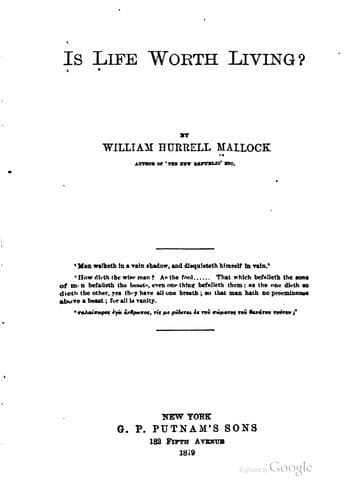
Is Life Worth Living?Mallock, W. H. (William Hurrell)
Philosophy
Is Life Worth Living?
Mallock, W. H. (William Hurrell)
Ethics; Life
are '_harsh_' truths. Why should '_harsh_' things be loveable? Or
supposing Mr. Stephen does love them, why is that love '_lofty_'? and
why should he so brusquely command all other men to share it? _Low_ and
_lofty_--what has Mr. Stephen to do with words like these? They are part
of the language of dreamland, not of real life. Mr. Stephen has no right
to them. If he has, he must be able to draw a hard and fast line between
them; for if his conceptions of them be '_vague in outline_' and
'_unsubstantial_,' they belong by his own express definition to the land
of dreams. But this is what Mr. Stephen, with the solemn imbecility of
his school, is quite incapable of seeing. Professor Huxley is in exactly
the same case. He says, as we have seen already, that, come what may of
it, our highest morality is to follow truth; that the '_lowest depth of
immorality_' is to _pretend to believe what we see no reason for
believing_;' and that our only proper reasons for belief are some
physical, some _perceptible_ evidence. And yet at the same time he says
that to '_attempt to upset morality_' by the help of the physical
sciences is about as rational or as possible as to '_attempt to upset
Euclid by the help of the Rig Veda_.' Now on Professor Huxley's
principles, this last sentence, though it sounds very weighty, is, if so
ungracious a word may be allowed me, nothing short of nonsense. It would
be the lowest depth of immorality, he says, to believe in God, when we
see that there is no physical evidence to justify the belief. And
physical science in this way he admits--he indeed proclaims--has upset
religion. How then has physical science in the same way failed to upset
morality? The foundation of morality, he says, is the belief that truth
for its own sake is sacred. But what proof can he discover of this
sacredness? Does any positive method of experience or observation so
much as tend to suggest it? We have already seen that it does not. What
Professor Huxley's philosophy really proves to him is that it is true
that nothing is sacred; not that it is a sacred thing to discover the
truth.
We saw all this already when we were examining his comparison of the
perception of moral beauty to the perception of the heat of ginger. It
is the same thing with which we are again dealing now, only we are
approaching it from a slightly different point of view. What we saw
before, was that without an assent to the religious dogmas, the moral
dogmas can have no logical meaning. We have now seen that even were the
two logically independent, they yet belong both of them to the same
order of things; and that if our tests of truth prove the former to be
illusions, they will, with precisely the same force, prove the same
thing of the latter.
Public-domain text, read in full here on John Shaqi.
Reviews
Reviews
No reviews yet
Be the first to share your thoughts on this work.
Elsewhere in the archive
Join the Discussion
Join the discussion
Sign in to leave a comment or review.
Sign InorCreate an account