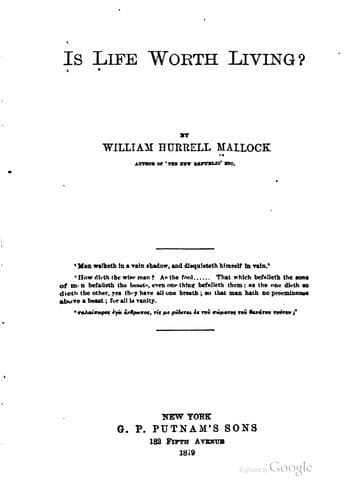
Is Life Worth Living?Mallock, W. H. (William Hurrell)
Philosophy
Is Life Worth Living?
Mallock, W. H. (William Hurrell)
Ethics; Life
But the most crucial test of all we have still to come to, which will
put this conclusion in a yet clearer and a more unmistakable light. Thus
far what we have seen has amounted to only this--that if science can
take from man his religious faith, it leaves him a being without any
moral guidance. What we shall now see is that, by the same arguments,
it will prove him to be not a moral being at all; that it will prove not
only that he has no rule by which to direct his will, but also that he
has no will to direct.
To understand this we must return to physical science, and to the exact
results that have been accomplished by it. We have seen how completely,
from one point of view, it has connected mind with matter, and how
triumphantly it is supposed to have unified the apparent dualism of
things. It has revealed the brain to us as matter in a combination of
infinite complexity, which it has reached at last through its own
automatic workings; and it has revealed consciousness to us as a
function of this brain, and as altogether inseparable from it. But for
this, the old dualism now supposed to be obsolete would remain
undisturbed. Indeed, if this doctrine were denied, such a dualism would
be the only alternative. For every thought, then, that we think, and
every feeling or desire that we feel, there takes place in the brain
some definite material movement, on the force or figure of which the
thoughts and feelings are dependent. Now if physical observations are to
be the only things that guide us, one important fact will become at once
evident. Matter existed and fermented long before the evolution of mind;
mind is not an exhibition of new forces, but the outcome of a special
combination of old. Mental facts are therefore essentially dependent on
molecular facts; molecular facts are not dependent on mental. They may
seem to be so, but this is only seeming. They are as much the outcome of
molecular groupings and movements as the figures in a kaleidoscope are
of the groupings and movements of the colored bits of glass. They are
things entirely by the way; and they can as little be considered links
in any chain of causes as can the figure in a kaleidoscope be called the
cause of the figure that succeeds it.
The conclusion, however, is so distasteful to most men, that but few of
them can be brought even to face it, still less to accept it. There is
not a single physicist of eminence--none at least who has spoken
publicly on the moral aspects of life--who has honestly and fairly
considered it, and said plainly whether he accepts it, rejects it, or is
in doubt about it. On the contrary, instead of meeting this question,
they all do their best to avoid it, and to hide it from themselves and
others in a vague haze of mystery. And there is a peculiarity in the
nature of the subject that has made this task an easy one. But the dust
they have raised is not impenetrable, and can, with a little patience,
be laid altogether.
Public-domain text, read in full here on John Shaqi.
Reviews
Reviews
No reviews yet
Be the first to share your thoughts on this work.
Elsewhere in the archive
Join the Discussion
Join the discussion
Sign in to leave a comment or review.
Sign InorCreate an account