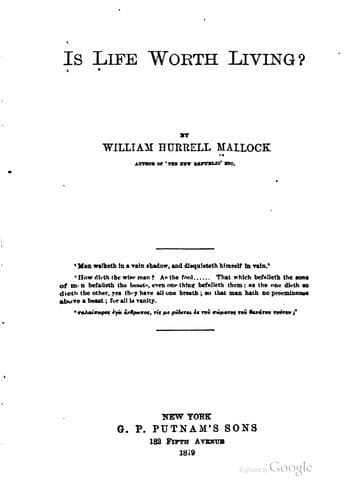
Is Life Worth Living?Mallock, W. H. (William Hurrell)
Philosophy
Is Life Worth Living?
Mallock, W. H. (William Hurrell)
Ethics; Life
The phenomenon of consciousness is in one way unique. It is the only
phenomenon with which science comes in contact, of which the scientific
imagination cannot form a coherent picture. It has a side, it is true,
that we can picture well enough--'_the thrilling of the nerves_,' as Dr.
Tyndall says, '_the discharging of the muscles, and all the subsequent
changes of the organism_.' But of how these changes come to have another
side, we can form no picture. This, it is perfectly true, is a complete
mystery. And this mystery it is that our modern physicists seize on, and
try to hide and lose in the shadow of it a conclusion which they admit
that, in any other case, a rigorous logic would force on them.
The following is a typical example of the way in which they do this. It
is taken from Dr. Tyndall. '_The mechanical philosopher, as such_,' he
says, '_will never place a state of consciousness and a group of
molecules in the position of mover and moved. Observation proves them to
interact; but in passing from one to the other, we meet a blank which
the logic of deduction is unable to fill.... I lay bare unsparingly the
initial difficulty of the materialist, and tell him that the facts of
observation which he considers so simple are "almost as difficult to be
seized as the idea of a soul." I go further, and say in effect: "If you
abandon the interpretation of grosser minds, who image the soul as a
Psyche which could be thrown out of the window--an entity which is
usually occupied we know not how, among the molecules of the brain, but
which on due occasion, such as the intrusion of a bullet, or the blow
of a club, can fly away into other regions of space--if abandoning this
heathen notion you approach the subject in the only way in which
approach is possible--if you consent to make your soul a poetic
rendering of a phenomenon which--as I have taken more pains than anyone
else to show you--refuses the ordinary yoke of physical laws, then I,
for one, would not object to this exercise of ideality." I say it
strongly, but with good temper, that the theologian who hacks and
scourges me for putting the matter in this light is guilty of black
ingratitude._'
Public-domain text, read in full here on John Shaqi.
Reviews
Reviews
No reviews yet
Be the first to share your thoughts on this work.
Elsewhere in the archive
Join the Discussion
Join the discussion
Sign in to leave a comment or review.
Sign InorCreate an account