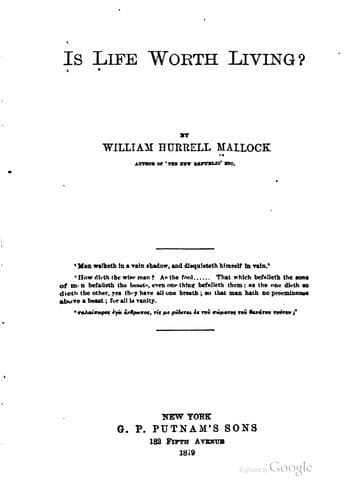
Is Life Worth Living?Mallock, W. H. (William Hurrell)
Philosophy
Is Life Worth Living?
Mallock, W. H. (William Hurrell)
Ethics; Life
First, they mean something, with which, as I have said already, we may
all agree. They mean that matter moving under certain laws (which may
possibly be part and parcel of its own essence) combines after many
changes into the human brain, every motion of which has its definite
connection with consciousness, and its definite correspondence to some
state of it. And this fact is a mystery, though it may be questioned if
it be more mysterious why matter should think of itself, than why it
should move of itself. At any rate, thus far we are all agreed; and
whatever mystery we may be dealing with, it is one that leaves us in
ignorance but not in doubt. The doubt comes in at the next step. We have
then not to wonder at one fact, but, the mystery being in either case
the same, to choose between two hypotheses. The first is that there is
in consciousness one order of forces only, the second is that there are
two. And when the positive school say that they reject neither of these,
what they really mean to say is that as to the second they neither dare
openly do one thing or the other--to deny it or accept it, but that they
remain like an awkward child when offered some more pudding, blushing
and looking down, and utterly unable to say either yes or no.
Now the question to ask the positive school is this. Why are they in
this state of suspense? '_There is an iron strength in the logic_,' as
Dr. Tyndall himself says, that rejects the second order altogether. The
hypothesis of its existence explains no fact of observation. The scheme
of nature, if it cannot be wholly explained without it, can, at any
rate, be explained better without it than with it. Indeed from the
standpoint of the thinker who holds that all that is is matter, it seems
a thing too superfluous, too unmeaning, to be even worth denial. And yet
the positive school announce solemnly that they will not deny it. Now
why is this? It is true that they cannot prove its non-existence; but
this is no reason for professing a solemn uncertainty as to its
existence. We cannot prove that each time a cab drives down Regent
Street a stick of barley-sugar is not created in Sirius. But we do not
proclaim, to the world our eternal ignorance as to whether or no this is
so. Why then should our positivists treat in this way the alleged
immaterial part of consciousness? Why this emphatic protestation on
their part that there may exist a something which, as far as the needs
of their science go, is superfluous, and as far as the logic of their
science goes is impossible? The answer is plain. Though their science
does not need it, the moral value of life does. As to that value they
have certain foregone conclusions, which they cannot resolve to abandon,
but which their science can make no room for. Two alternatives are
offered them--to admit that life has not the meaning they thought it
had, or that their system has not the completeness they thought it had;
and of these two alternatives they will accept neither.
Public-domain text, read in full here on John Shaqi.
Reviews
Reviews
No reviews yet
Be the first to share your thoughts on this work.
Elsewhere in the archive
Join the Discussion
Join the discussion
Sign in to leave a comment or review.
Sign InorCreate an account