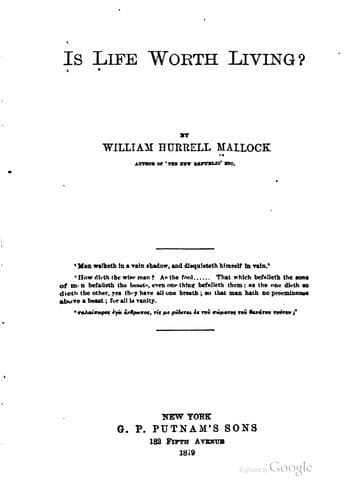
Is Life Worth Living?Mallock, W. H. (William Hurrell)
Philosophy
Is Life Worth Living?
Mallock, W. H. (William Hurrell)
Ethics; Life
They could tell
us '_with an iron strength of logic_' that all human sorrow was as
involuntary and as unmeaning as sea-sickness; that love and faith were
but distillations of what exists diluted in mutton-chops and beer; and
that the voice of one crying in the wilderness was nothing but an
automatic metamorphosis of the locusts and wild honey. They could tell
us '_with an iron strength of logic_' that all the thoughts and moral
struggles of humanity were but as the clanging whirr of a machine, which
if a little better adjusted might for the future go on spinning in
silence. But they see that the discovery on man's part that his life was
nothing more than this would mean a complete change in its mechanism,
and that thenceforward its entire action would be different. They
therefore seek a refuge in saying it _may_ be more than this. But what
do they mean by _may be_? Do they mean that in spite of all that science
can teach them, in spite of that uniformity absolute and omnipresent
which alone it reveals to them, which day by day it is forcing with more
vividness on their imaginations, and which seems to have no room for
anything besides itself--do they mean that in spite of this there may
still be a second something, a power of a different order, acting on
man's brain and grappling with its automatic movements? Do they mean
that that '_heathen_' and '_gross_' conception of an immaterial soul is
probably after all the true one? Either they must mean this or else they
must mean the exact opposite. There is no third course open to them.[36]
Their opinion, as soon as they form one, must rest either on this
extreme or that. They will see, as exact and scientific thinkers, that
if it be not practically certain that there is some supernatural entity
in us, it is practically certain that there is not one. To say merely
that it _may_ exist is but to put an ounce in one scale whilst there is
a ton in the other. It is an admission that is utterly dead and
meaningless. They can only entertain the question of its existence
because its existence is essential to man as a moral being. The only
reason that can tempt us to say it _may_ be forces us in the same moment
to say that it _must_ be, and that it _is_.
Which answer eventually the positive school will choose, and which
answer men in general will accept, I make as I have said before, no
attempt to answer. My only purpose to show is, that if man has any moral
being at all, he has it in virtue of his _immaterial_ will--a force, a
something of which physical science can give no account whatever, and
which it has no shadow of authority either for affirming or for denying;
and further, that if we are not prevented by it from affirming his
immaterial will, we are not prevented from affirming his immortality,
and the existence of God likewise.
Public-domain text, read in full here on John Shaqi.
Reviews
Reviews
No reviews yet
Be the first to share your thoughts on this work.
Elsewhere in the archive
Join the Discussion
Join the discussion
Sign in to leave a comment or review.
Sign InorCreate an account