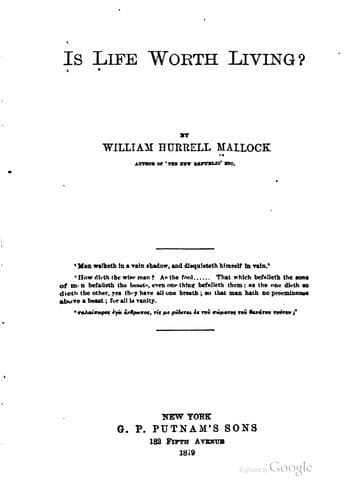
Is Life Worth Living?Mallock, W. H. (William Hurrell)
Philosophy
Is Life Worth Living?
Mallock, W. H. (William Hurrell)
Ethics; Life
Such is the position of agnostics, when brought face to face with the
world. They are undecided only about one question, and this is the one
question which cannot be left undecided. Men cannot remain agnostics as
to belief that their actions must depend upon, any more than a man who
is compelled to go on walking can refrain from choosing one road or
other when there are two open to him. Nor does it matter that our
believing may in neither case amount to a complete certitude. It is
sufficient that the balance of probability be on one side or the other.
Two ounces will out-weigh one ounce, quite as surely as a ton will. But
what our philosophers profess to teach us (in so far as they profess to
be agnostics, and disclaim being dogmatists) is, that there is no
balance either way. The message they shout to us is, that they have no
message at all; and that because they are without one, the whole world
is in the same condition.
CHAPTER X.
MORALITY AND NATURAL THEISM.
_Credo quia impossibile est._
If we look calmly at the possible future of human thought, it will
appear from what we have just seen, that physical science of itself can
do little to control or cramp it; nor until man consents to resign his
belief in virtue and his own dignity altogether, will it be able to
repress religious faith, should other causes tend to produce a new
outbreak of it. But the chief difficulties in the matter are still in
store for us. Let us see never so clearly that science, if we are moral
beings, can do nothing to weaken our belief in God and immortality, but
still leaves us free, if we will, to believe in them, it seems getting
clearer and yet more clear that these beliefs are inconsistent with
themselves, and conflict with these very moral feelings, of which they
are invoked as an explanation. Here it is true that reason does confront
us, and what answer to make to it is a very serious question. This
applies even to natural religion in its haziest and most compliant form;
and as applied to any form of orthodoxy its force is doubled. What we
have seen thus far is, that if there be a moral world at all, our
knowledge of nature contains nothing inconsistent with theism. We have
now to enquire how far theism is inconsistent with our conceptions of
the moral world.
In treating these difficulties, we will for the present consider them as
applying only to religion in general, not to any special form of it. The
position of orthodoxy we will reserve for a separate treatment. For
convenience' sake, however, I shall take as a symbol of all religion the
vaguer and more general teachings of Christianity; but I shall be
adducing them not as teachings revealed by heaven, but simply as
developed by the religious consciousness of men.
Public-domain text, read in full here on John Shaqi.
Reviews
Reviews
No reviews yet
Be the first to share your thoughts on this work.
Elsewhere in the archive
Join the Discussion
Join the discussion
Sign in to leave a comment or review.
Sign InorCreate an account