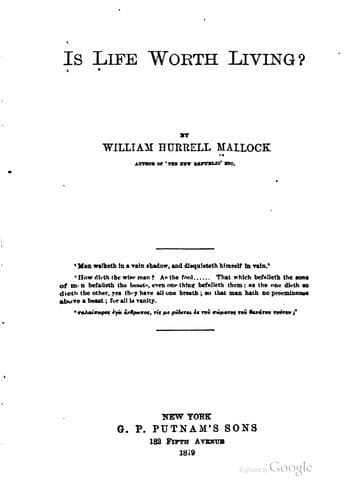
Is Life Worth Living?Mallock, W. H. (William Hurrell)
Philosophy
Is Life Worth Living?
Mallock, W. H. (William Hurrell)
Ethics; Life
To begin then with the great primary difficulties: these, though they
take various forms, can all in the last resort be reduced to two--the
existence of evil in the face of the power of God, and the freedom of
man's will in the face of the will of God. And what I shall try to make
plain with respect to these is this: not that they are not
difficulties--not that they are not insoluble difficulties; but that
they are not difficulties due to religion or theism, nor by abandoning
theism can we in any way escape from them. They start into being not
with the belief in God, and a future of rewards and punishments, but
with the belief in the moral law and in virtue, and they are common to
all systems in which the worth of virtue is recognised.
The vulgar view of the matter cannot be better stated than in the
following account given by J.S. Mill of the anti-religious reasonings of
his father. He looked upon religion, says his son, '_as the greatest
enemy of morality; first, by setting up fictitious excellences--belief
in creeds, devotional feelings, and ceremonies, not connected with the
good of humankind, and causing them to be accepted as substitutes for
genuine virtues_; but above all _by radically vitiating the standard of
morals, making it consist in doing the will of a being, on whom, indeed,
it lavishes all the phrases of adulation, but whom, in sober truth, it
depicts as eminently hateful. I have a hundred times heard him say that_
all ages and nations have represented their gods as wicked _in a
constantly increasing progression; that mankind had gone on adding trait
after trait, till they reached the most perfect expression of wickedness
which the human mind can devise, and have called this God, and
prostrated themselves before it. The_ ne plus ultra _of wickedness he
considered to be embodied in what is commonly presented to mankind as
the creed of Christianity. Think (he used to say) of a being who would
make a hell--who would create the human race with the infallible
foreknowledge, and therefore with the intention, that the great majority
of them, should be consigned to horrible and everlasting torment._'
James Mill, adds his son, knew quite well that Christians were not, in
fact, as demoralised by this monstrous creed as, if they were logically
consistent, they ought to be. '_The same slovenliness of thought (he
said) and subjection of the reason to fears, wishes, and affections,
which enable them to accept a theory involving a contradiction in terms,
prevent them from perceiving the logical consequence of the theory._'
Public-domain text, read in full here on John Shaqi.
Reviews
Reviews
No reviews yet
Be the first to share your thoughts on this work.
Elsewhere in the archive
Join the Discussion
Join the discussion
Sign in to leave a comment or review.
Sign InorCreate an account