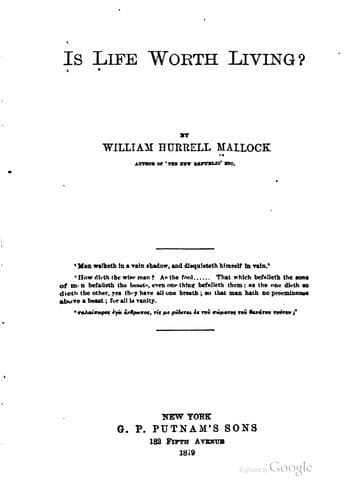
Is Life Worth Living?Mallock, W. H. (William Hurrell)
Philosophy
Is Life Worth Living?
Mallock, W. H. (William Hurrell)
Ethics; Life
What shall it say, then, when assailed by the rational moralist? It will
not deny its own condition, but it will show its opponent that his is
really the same. It will show him that, let him give his morality what
base he will, he cannot conceive of things without the same
contradiction in terms. If good be a thing of any spiritual value--if it
be, in other words, what every moral system supposes it to be--that good
can co-exist with evil is just as unthinkable as that God can. The value
of moral good is supposed to lie in this--that by it we are put _en
rapport_ with something that is better than ourselves--some '_stream of
tendency_,' let us say, '_that makes for righteousness_,' But if this
stream of tendency be not a personal God, what is it? Is it Nature?
Nature, we have seen already, is open to just the same objections that
God is. It is equally guilty of all the evil that is contained in it. Is
it Truth, then--pure Truth for its own sake? Again, we have seen already
that as little can it be that. Is it Human Nature as opposed to
Nature?--Man as distinct from, and holier than, any individual men? Of
all the substitutes for God this at first sight seems the most
promising, or, at any rate, the most practical. But, apart from all the
other objections to this, which we have already been considering in such
detail, it will very soon be apparent that it involves the very same
inconsistency, the same contradiction in terms. The fact of moral evil
still confronts us, and the humanity to which we lift our hearts up is
still taxable with that. But perhaps we separate the good in humanity
from the evil, and only worship the former as struggling to get free
from the latter. This, however, will be of little help to us. If what we
call humanity is nothing but the good part of it, we can only vindicate
its goodness at the expense of its strength. Evil is at least an equal
match for it, and in most of the battles hitherto it is evil that has
been victorious. But to conceive of good in this way is really to
destroy our conception of it. Goodness is in itself an incomplete
notion; it is but one facet of a figure which, approached from other
sides, appears to us as eternity, as omnipresence, and, above all, as
supreme strength; and to reduce goodness to nothing but the higher part
of humanity--to make it a wavering fitful flame that continually sinks
and flickers, that at its best can but blaze for a while, and at its
brightest can throw no light beyond this paltry parish of a world--is to
deprive it of its whole meaning and hold on us. Or again, even were this
not so, and could we believe, and be strengthened by believing, that the
good in humanity would one day gain the victory, and that some higher
future, which even we might partake in by preparing, was in store for
the human race, would our conception of the matter then be any more
harmonious? As we surveyed our race as a whole, would its brighter
Public-domain text, read in full here on John Shaqi.
Reviews
Reviews
No reviews yet
Be the first to share your thoughts on this work.
Elsewhere in the archive
Join the Discussion
Join the discussion
Sign in to leave a comment or review.
Sign InorCreate an account