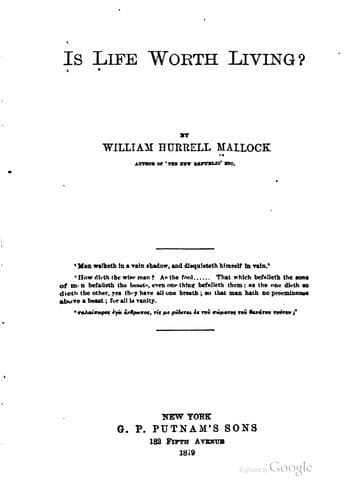
Is Life Worth Living?Mallock, W. H. (William Hurrell)
Philosophy
Is Life Worth Living?
Mallock, W. H. (William Hurrell)
Ethics; Life
Now, in spite of its coarse and exaggerated acrimony, this passage
doubtless expresses a great truth, which presently I shall go on to
consider. But it contains also a very characteristic falsehood, of which
we must first divest it. God is here represented as _making_ a hell,
with the express intention of forcibly putting men into it, and His main
hatefulness consists in this capricious and wanton cruelty. Such a
representation is, however, an essentially false one. It is not only not
true to the true Christian teaching, but it is absolutely opposed to it.
The God of Christianity does not _make_ hell; still less does He
deliberately put men into it. It is made by men themselves; the essence
of its torment consists in the loss of God; and those that lose Him,
lose Him by their own act, from having deliberately made themselves
incapable of loving Him. God never wills the death of the sinner. It is
to the sinner's own will that the sinner's death is due.
All this rhetoric, therefore, about God's malevolence and wickedness is
entirely beside the point, nor does it even touch the difficulty that,
in his heart, James Mill is aiming at. His main difficulty is nothing
more than this: How can an infinite will that rules everywhere, find
room for a finite will not in harmony with itself? Whilst the only
farther perplexity that the passage indicates, is the existence of those
evil conditions by which the finite will, already so weak and wavering,
is yet farther hampered.
Now these difficulties are doubtless quite as great as James Mill
thought they were; but we must observe this, that they are not of the
same kind. They are merely intellectual difficulties. They are not moral
difficulties at all. Mill truly says that they involve a contradiction
in terms. But why? Not, as Mill says, because a wicked God is set up as
the object of moral worship, but because, in spite of all the wickedness
existing, the Author of all existences is affirmed not to be wicked.
Nor, again, is Mill right in saying that this contradiction is due to
'_slovenliness of thought_.' Theology accepts it with its eyes wide
open, making no attempt to explain the inexplicable; and the human will
it treats in the same way. It makes no offer to us to clear up
everything, or to enable thought to put a girdle round the universe. On
the contrary, it proclaims with emphasis that its first axioms are
unthinkable; and its most renowned philosophic motto is, '_I believe
because it is impossible_.'
Public-domain text, read in full here on John Shaqi.
Reviews
Reviews
No reviews yet
Be the first to share your thoughts on this work.
Elsewhere in the archive
Join the Discussion
Join the discussion
Sign in to leave a comment or review.
Sign InorCreate an account