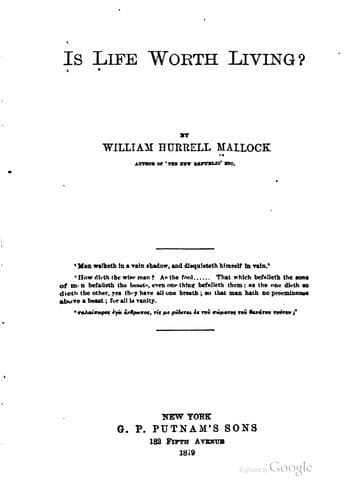
Is Life Worth Living?Mallock, W. H. (William Hurrell)
Philosophy
Is Life Worth Living?
Mallock, W. H. (William Hurrell)
Ethics; Life
Now considering the way in which I have just spoken of Protestantism, it
may seem to many that I have dismissed this question already. With the
'_enlightened_' English thinker such certainly will be the first
impression. But there is one point that such thinkers all forget:
Protestant Christianity is not the only form of it. They have still the
form to deal with which is the oldest, the most legitimate, and the most
coherent--the Church of Rome. They surely cannot forget the existence of
this Church or her magnitude. To suppose this would be to attribute to
them too insular, or rather too provincial, an ignorance. The cause,
however, certainly is ignorance, and an ignorance which, though less
surprising, is far deeper. In this country the popular conception of
Rome has been so distorted by our familiarity with Protestantism, that
the true conception of her is something quite strange to us. Our divines
have exhibited her to us as though she were a lapsed Protestant sect,
and they have attacked her for being false to doctrines that were never
really hers. They have failed to see that the first and essential
difference which separates her from them lies, primarily not in any
special dogma, but in the authority on which all her dogmas rest.
Protestants, basing their religion on the Bible solely, have conceived
that Catholics of course profess to do so likewise; and have covered
them with invective for being traitors to their supposed profession. But
the Church's primary doctrine is her own perpetual infallibility. She is
inspired, she declares, by the same Spirit that inspired the Bible; and
her voice is, equally with the Bible, the voice of God. This theory,
however, upon which really her whole fabric rests, popular
Protestantism either ignores altogether, or treats it as if it were a
modern superstition, which, so far from being essential to the Church's
system, is, on the contrary, inconsistent with it. Looked at in this
way, Rome to the Protestant's mind has seemed naturally to be a mass of
superstitions and dishonesties; and it is this view of her that,
strangely enough, our modern advanced thinkers have accepted without
question. Though they have trusted the Protestants in nothing else, they
have trusted them here. They have taken the Protestants' word for it,
that Protestantism is more reasonable than Romanism; and they think,
therefore, that if they have destroyed the former, _a fortiori_ have
they destroyed the latter.[41]
Public-domain text, read in full here on John Shaqi.
Reviews
Reviews
No reviews yet
Be the first to share your thoughts on this work.
Elsewhere in the archive
Join the Discussion
Join the discussion
Sign in to leave a comment or review.
Sign InorCreate an account