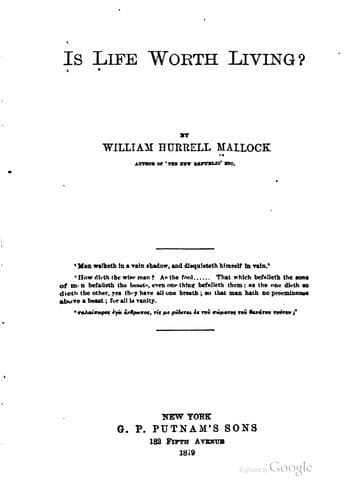
Is Life Worth Living?Mallock, W. H. (William Hurrell)
Philosophy
Is Life Worth Living?
Mallock, W. H. (William Hurrell)
Ethics; Life
No conception of the matter, however, could be more false than this. To
whatever criticism the Catholic position may be open, it is certainly
not thus included in Protestantism, nor is it reached through it. Let us
try and consider the matter a little more truly. Let us grant all that
hostile criticism can say against Protestantism as a supernatural
religion: in other words, let us set it aside altogether. Let us suppose
nothing, to start with, in the world but a natural moral sense, and a
simple natural theism; and let us then see the relation of the Church of
Rome to that. Approached in this way, the religious world will appear to
us as a body of natural theists, all agreeing that they must do God's
will, but differing widely amongst themselves as to what His will and
His nature are. Their moral and religious views will be equally vague
and dreamlike--more dreamlike even than those of the Protestant world at
present. Their theories as to the future will be but '_shadowy hopes and
fears_.' Their practice, in the present, will vary from asceticism to
the widest license. And yet, in spite of all this confusion and
difference, there will be amongst them a vague tendency to unanimity.
Each man will be dreaming his own spiritual dream, and the dreams of all
will be different. All their dreams, it will be plain, cannot represent
reality; and yet the belief will be common to all that some common
reality is represented by them. Men, therefore, will begin to compare
their dreams together, and try to draw out of them the common element,
so that the dream may come slowly to be the same for all; that, if it
grows, it may grow by some recognizable laws; that it may, in other
words, lose its character of a dream, and assume that of a reality. We
suppose, therefore, that our natural theists form themselves into a kind
of parliament, in which they may compare, adjust, and give shape to the
ideas that were before so wavering, and which shall contain some
machinery for formulating such agreements as may be come to. The common
religious sense of the world is thus organized, and its conclusions
registered. We have no longer the wavering _dreams_ of men; we have
instead of them the constant _vision_ of man.
Public-domain text, read in full here on John Shaqi.
Reviews
Reviews
No reviews yet
Be the first to share your thoughts on this work.
Elsewhere in the archive
Join the Discussion
Join the discussion
Sign in to leave a comment or review.
Sign InorCreate an account