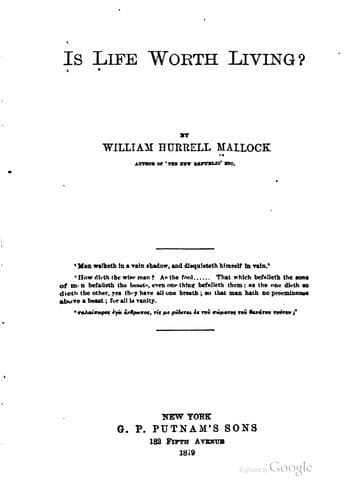
Is Life Worth Living?Mallock, W. H. (William Hurrell)
Philosophy
Is Life Worth Living?
Mallock, W. H. (William Hurrell)
Ethics; Life
The Church, as has been said already, is ideally the parliament of the
whole believing world; but we find, as a matter of fact, that she is the
parliament of a small part only. Now what shall we say to this? If God
would have all men do His will, why should He place the knowledge of it
within reach of such a small minority of them? And to this question we
can give no answer. It is a mystery, and we must acknowledge frankly
that it is one. But there is this to say yet--that it is not a new
mystery. We already suppose ourselves to have accepted it in a simpler
form: in the form of the presence of evil, and the partial prevalence of
good. By acknowledging the claim of the special revelation in question,
we are not adding to the complexity of that old world-problem. I am
aware, however, that many think just the reverse of this. I will
therefore dwell upon the subject for a few moments longer. To many who
can accept the difficulty of the partial presence of good, the
difficulty seems wantonly aggravated by the claims of a special
revelation. These claims seem to them to do two things. In the first
place, they are thought to make the presence of good even more partial
than it otherwise would be; and secondly--which is a still greater
stumbling-block--to oblige us to condemn as evil much that would else
seem good of the purest kind. There are many men, as we must all know,
without the Church, who are doing their best to fight their way to God;
and orthodoxy is supposed to pass a cruel condemnation on these, because
they have not assented to some obscure theory, their rejection or
ignorance of which has plainly stained neither their lives nor hearts.
And of orthodoxy under certain forms this is no doubt true; but it is
not true of the orthodoxy of Catholicism. There is no point, probably,
connected with this question, about which the general world is so
misinformed and ignorant, as the sober but boundless charity of what it
calls the anathematising Church. So little indeed is this charity
understood generally, that to assert it seems a startling paradox. Most
paradoxes are doubtless in reality the lies they at first sight seem to
be; but not so this one. It is the simple statement of a fact. Never was
there a religious body, except the Roman, that laid the intense stress
she does on all her dogmatic teachings, and had yet the justice that
comes of sympathy for those that cannot receive them. She condemns no
goodness, she condemns even no earnest worship, though it be outside her
pale. On the contrary, she declares explicitly that a knowledge of '_the
one true God, our Creator and Lord_,' may be attained to by the
'_natural light of human reason_,' meaning by '_reason_' faith
unenlightened by revelation; and she declares those to be anathema who
deny this. The holy and humble men of heart who do not know her, or who
in good faith reject her, she commits with confidence to God's
uncovenanted mercies; and these she knows are infinite; but, except as
Public-domain text, read in full here on John Shaqi.
Reviews
Reviews
No reviews yet
Be the first to share your thoughts on this work.
Elsewhere in the archive
Join the Discussion
Join the discussion
Sign in to leave a comment or review.
Sign InorCreate an account