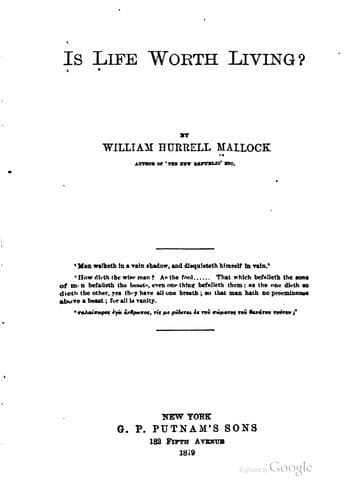
Is Life Worth Living?Mallock, W. H. (William Hurrell)
Philosophy
Is Life Worth Living?
Mallock, W. H. (William Hurrell)
Ethics; Life
revealed to her, she can of necessity say nothing distinct about them.
It is admitted by the world at large, that of her supposed bigotry she
has no bitterer or more extreme exponents than the Jesuits; and this is
what a Jesuit theologian says upon this matter: '_A heretic, so long as
he believes his sect to be more or equally deserving of belief, has no
obligation to believe the Church ... [and] when men who have been
brought up in heresy, are persuaded from boyhood that we impugn and
attack the word of God, that we are idolaters, pestilent deceivers, and
are therefore to be shunned as pestilence, they cannot, while this
persuasion lasts, with a safe conscience hear us._'[42] Thus for those
without her the Church has one condemnation only. Her anathemas are on
none but those who reject her with their eyes open, by tampering with a
conviction that she really is the truth. These are condemned, not for
not seeing that the teacher is true, but because having really seen
this, they continue to close their eyes to it. They will not obey when
they know they ought to obey. And thus the moral offence of a Catholic
in denying some recondite doctrine, does not lie merely, and need not
lie at all, in the immediate bad effects that such a denial would
necessitate; but in the disobedience, the self-will, and the rebellion
that must in such a case be both a cause and a result of it.
In the light of these considerations, though the old perplexity of evil
will still confront us, it will be seen that the claims of Catholic
orthodoxy do nothing at all to add to it. If orthodoxy, however, admit
so much good without itself, we may perhaps be inclined to ask what
special good it claims within itself, and what possible motives can
exist for either understanding or teaching it. But we might ask with
exactly equal force, what is the good of true physical science, and why
should we try to impress on the world its teachings? Such a question, we
can at once see, is absurd. Because a large number of men know nothing
of physical science, and are apparently not the worse for their
ignorance, we do not for that reason think physical science worthless.
We believe, on the whole, that a knowledge of the laws of matter,
including those of our organisms and their environments, will steadily
tend to better our lives, in so far as they are material. It will tend,
for instance, to a better preservation of our health. But we do not for
this reason deny that many individuals may preserve their health who are
but very partially acquainted with the laws of it. Nor do we deny the
value of a thorough study of astronomy and meteorology because a certain
practical knowledge of the weather and of navigation may be attained
without it. On the contrary, we hold that the fullest knowledge we can
acquire on such matters it is our duty to acquire, and not acquire only,
but as far as possible promulgate. It is true that the mass of men may
Public-domain text, read in full here on John Shaqi.
Reviews
Reviews
No reviews yet
Be the first to share your thoughts on this work.
Elsewhere in the archive
Join the Discussion
Join the discussion
Sign in to leave a comment or review.
Sign InorCreate an account