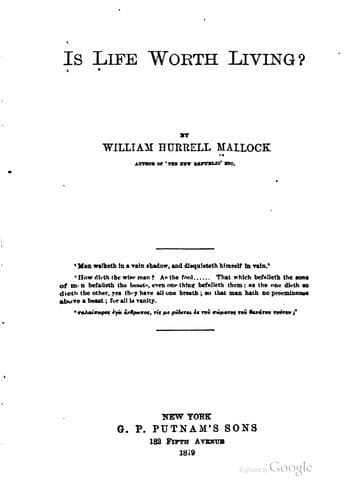
Is Life Worth Living?Mallock, W. H. (William Hurrell)
Philosophy
Is Life Worth Living?
Mallock, W. H. (William Hurrell)
Ethics; Life
never master such knowledge thoroughly; but what they do master of it we
feel convinced should be the truth, and even what they do not, will, we
feel convinced, be some indirect profit to them. And the case of
spiritual science is entirely analogous to the case of natural science.
A man to whom the truth is open is not excused from finding it because
he knows it is not so open to all. A heretic who denies the dogmas of
the Church has his counterpart in the quack who denies the verified
conclusions of science. The moral condemnation that is given to the one
is illustrated by the intellectual condemnation that is given to the
other.
If we will think this over carefully, we shall get a clearer view of the
moral value claimed for itself by orthodoxy. Some of its doctrines, the
great and picturable parts of them, that appeal to all, and that in some
degree can be taken in by all, it declares doubtless to be saving, in
their own nature. But for the mass of men the case is quite different
with the facts underlying these. That we eat Christ's body in the
Eucharist is a belief that, in a practical way, can be understood
perfectly by anyone; but the philosophy that is involved in this belief
would be to most men the merest gibberish. Yet it is no more unimportant
that those who do understand this philosophy, should do so truly and
transmit it faithfully, than it is unimportant that a physician should
understand the action of alcohol, because anyone independent of such
knowledge can tell that so many glasses of wine will have such and such
an effect on him. Theology is to the spiritual body what anatomy and
medicine are to the natural body. The parts they each play in our lives
are analogous, and in their respective worlds their _raison d'etre_ is
the same. What then can be shallower than the rhetoric of such thinkers
as Mr. Carlyle, in which natural religion and orthodoxy are held up to
us as contrasts and as opposites, the former being praised as simple and
going straight to the heart, and the latter described and declaimed
against as the very reverse of this? '_On the one hand_,' it is said,
'_see the soul going straight to its God, feeling His love, and content
that others should feel it. On the other hand, see this pure and free
communion, distracted and interrupted by a thousand tortuous reasonings
as to the exact nature of it. What can obscure intellectual
propositions,_' it is asked, '_have to do with a religion of the heart?
And do not they check the latter by being thus bound up with it?_' But
what really can be more misleading than this? Natural religion is
doubtless simpler in one sense than revealed religion; but it is only
simple because it has no authoritative science of itself. It is simple
for the same reason that a boy's account of having given himself a
headache is simpler than a physician's would be. The boy says merely,
'_I ate ten tarts, and drank three bottles of ginger-beer._' The
Public-domain text, read in full here on John Shaqi.
Reviews
Reviews
No reviews yet
Be the first to share your thoughts on this work.
Elsewhere in the archive
Join the Discussion
Join the discussion
Sign in to leave a comment or review.
Sign InorCreate an account