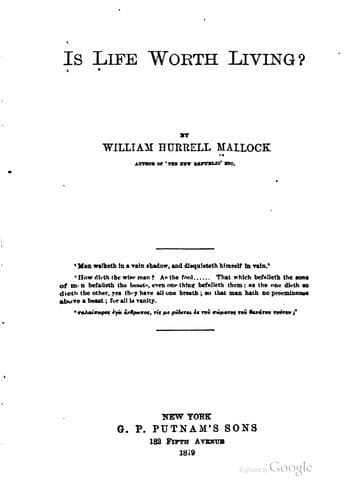
Is Life Worth Living?Mallock, W. H. (William Hurrell)
Philosophy
Is Life Worth Living?
Mallock, W. H. (William Hurrell)
Ethics; Life
well worth his attention--that the duration of pains in purgatory is
according to Bellarmine, '_so completely uncertain, that it is rash to
pretend to determine anything about it_.'
Here is one instance, that will be as good as many, of the way in which
the private opinions of individual Catholics, or the transitory opinions
of particular epochs, are taken for the unalterable teachings of the
Catholic Church herself; and it is no more logical to condemn the latter
as false because the former are, than it would be to say that all modern
geography is false because geographers may still entertain false
opinions about regions as to which they do not profess certainty.
Mediaeval doctors thought that purgatory might be the middle of the
earth. Modern geographers have thought that there might be an open sea
at the North Pole. But that wrong conjectures have been hazarded in both
cases, can prove in neither that there have been no true discoveries.
The Church, it is undeniable, has for a long time lived and moved
amongst countless false opinions; and to the external eye they have
naturally seemed a part of her. But science moves on, and it is shown
that she can cast them off. She has cast off some already; soon
doubtless she will cast off others; not in any petulant anger, but with
a composed determined gentleness, as some new light gravely dawns upon
her.
Granting all this, however, there remains a yet subtler characteristic
of the Church, which goes to make her a rock of offence to many; and
that is, the temper and the intellectual tone which she seems to develop
in her members. But here, again, we must call to our aid considerations
similar to those we have just been dwelling on. We must remember that
the particular tone and temper that offends us is not necessarily
Catholicism. The temper of the Catholic world may change, and, as a
matter of fact, does change. It is not the same, indeed, in any two
countries, or in any two eras. And it may have a new and unsuspected
future in store for it. It may absorb ideas that we should consider
broader, bolder, and more rational than any it seems to possess at
present. But if ever it does so, the Church, in the opinion of
Catholics, will not be growing false to herself; she will only, in due
time, be unfolding her own spirit more fully. Thus some people associate
Catholic conceptions of extreme sanctity with a neglect of personal
cleanliness; and imagine that a clean Catholic can, according to his own
creed, never come very near perfection. But the Church has never given
this view her sanction; she has never made it of faith that dirt is
sacred; she has added no ninth beatitude in favour of an unchanged
shirt. Many of the greatest saints were doubtless dirty; but they were
dirty not because of the Church they belonged to, but because of the age
they lived in. Such an expression of sanctity for themselves, it is
probable, will be loathed by the saints of the future; yet they may none
Public-domain text, read in full here on John Shaqi.
Reviews
Reviews
No reviews yet
Be the first to share your thoughts on this work.
Elsewhere in the archive
Join the Discussion
Join the discussion
Sign in to leave a comment or review.
Sign InorCreate an account