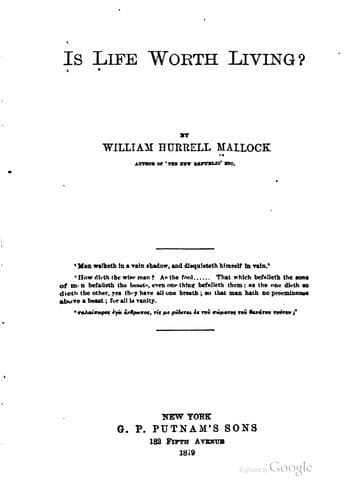
Is Life Worth Living?Mallock, W. H. (William Hurrell)
Philosophy
Is Life Worth Living?
Mallock, W. H. (William Hurrell)
Ethics; Life
the less reverence, for all that, the saints who so expressed it in the
past. This is but a single instance; but it may serve as a type of the
wide circle of changes that the Church as a living organism, still full
of vigour and power of self-adaptation, will be able to develop, as the
world develops round her, and yet lose nothing of her supernatural
sameness.
To sum up, then; if we would obtain a true view of the general character
of Catholicism, we must begin by making a clean sweep of all the views
that, as outsiders, we have been taught to entertain about her. We must,
in the first place, learn to conceive of her as a living, spiritual
body, as infallible and as authoritative now as she ever was, with her
eyes undimmed and her strength not abated, continuing to grow still as
she has continued to grow hitherto: and the growth of the new dogmas
that she may from time to time enunciate, we must learn to see are, from
her own stand-point, signs of life and not signs of corruption. And
further, when we come to look into her more closely, we must separate
carefully the diverse elements we find in her--her discipline, her pious
opinions, her theology, and her religion.
Let honest enquirers do this to the best of their power, and their views
will undergo an unlooked-for change. Other difficulties of a more
circumstantial kind, it is true, still remain for them; and of these I
shall speak presently. But putting these for the moment aside, and
regarding the question under its widest aspects only--regarding it only
in connection with the larger generalisations of science, and the
primary postulates of man's spiritual existence--the theist will find in
Catholicism no new difficulties. He will find in it the logical
development of our natural moral sense, developed, indeed, and still
developing, under a special and supernatural care--but essentially the
same thing; with the same negations, the same assertions, the same
positive truths, and the same impenetrable mysteries; and with nothing
new added to them, but help, and certainty, and guidance.
FOOTNOTES:
[37] It is curious to reflect that what Gibbon said as a sarcasm, is
really a serious and profound truth, and leads to conclusions exactly
opposite to those drawn from it in that witty and most fascinating
chapter from which the above words are quoted.
[38] _Our Eternal Hope._ By Canon Farrar.
[39] See Doellinger's _Continuation of Hortig's Church History_, quoted
by Mr. J.B. Robertson, in his _Memoir of Dr. Moehler_.
[40] See _Phases of my Faith_, by Francis Newman.
Public-domain text, read in full here on John Shaqi.
Reviews
Reviews
No reviews yet
Be the first to share your thoughts on this work.
Elsewhere in the archive
Join the Discussion
Join the discussion
Sign in to leave a comment or review.
Sign InorCreate an account