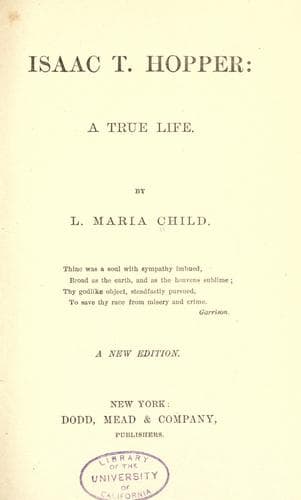
Fugitive slaves -- United States; Hopper, Isaac T. (Isaac Tatem), 1771-1852
ISAAC T. HOPPER
A True Life
BY
L. MARIA CHILD
1853
[Illustration: Isaac T. Hopper]
Thine was a soul with sympathy imbued,
Broad as the earth, and as the heavens sublime;
Thy godlike object, steadfastly pursued,
To save thy race from misery and crime.
Garrison.
TO
HANNAH ATTMORE HOPPER,
WIDOW OF THE LATE
ISAAC T. HOPPER,
THIS VOLUME IS RESPECTFULLY AND AFFECTIONATELY INSCRIBED, BY HER
GRATEFUL AND ATTACHED FRIEND,
L. MARIA CHILD.
PREFACE.
This biography differs from most works of the kind, in embracing
fragments of so many lives. Friend Hopper lived almost entirely for
others; and it is a striking illustration of the fact, that I have found
it impossible to write his biography without having it consist largely
of the adventures of other people.
I have not recounted his many good deeds for the mere purpose of
eulogizing an honored friend. I have taken pleasure in preserving them
in this form, because I cherish a hope that they may fall like good seed
into many hearts, and bring forth future harvests in the great field of
humanity.
Most of the strictly personal anecdotes fell from his lips in familiar
and playful conversation with his sister, or his grand-children, or his
intimate friends, and I noted them down at the time, without his
knowledge. In this way I caught them in a much more fresh and natural
form, than I could have done if he had been conscious of the process.
The narratives and anecdotes of fugitive slaves, which form such a
prominent portion of the book, were originally written by Friend Hopper
himself, and published in newspapers, under the title of "Tales of
Oppression." I have re-modelled them all; partly because I wished to
present them in a more concise form, and partly because the principal
actor could be spoken of more freely by a third person, than he could
speak of himself. Moreover, he had a more dramatic way of _telling_ a
story than he had of _writing_ it; and I have tried to embody his
unwritten style as nearly as I could remember it. Where-ever incidents
or expressions have been added to the published narratives, I have done
it from recollection.
The facts, which were continually occurring within Friend Hopper's
personal knowledge, corroborate the pictures of slavery drawn by Mrs.
Stowe. Her descriptions are no more fictitious, than the narratives
written by Friend Hopper. She has taken living characters and facts of
every-day occurrence, and combined them in a connected story, radiant
with the light of genius, and warm with the glow of feeling. But is a
landscape any the less real, because there is sunshine on it, to bring
out every tint, and make every dew-drop sparkle?
Public-domain text, read in full here on John Shaqi.
Reviews
Reviews
No reviews yet
Be the first to share your thoughts on this work.
Join the Discussion
Join the discussion
Sign in to leave a comment or review.
Sign InorCreate an account