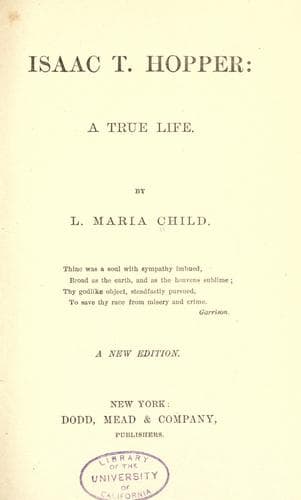
Fugitive slaves -- United States; Hopper, Isaac T. (Isaac Tatem), 1771-1852
At the succeeding term, the case was tried again, with renewed energy
and zeal. But the jury, after being kept together ten days, were
discharged without being able to agree upon a verdict. Some, who were
originally in favor of the defendant, became weary of their long
confinement, and consented to go over to the slaveholder's side; but one
of them, named Benjamin Thaw, declared that he would eat his Christmas
dinner in the jury-room, before he would consent to such a flagrant act
of injustice.
His patience held out till the court adjourned. Consequently a third
trial became necessary; and the third jury brought in a verdict in favor
of the watchmaker.
The expenses of these suits were estimated at seventeen hundred dollars.
Solomon Low was in limited circumstances; and this expenditure in
prosecuting an innocent man was said to have caused his failure soon
after.
THE DISGUISED SLAVEHOLDER.
A colored woman and her son were slaves to a man in East Jersey. She had
two sons in Philadelphia, who had been free several years, and her
present master was unacquainted with them. In 1827, she and her younger
son escaped, and went to live in Philadelphia. Her owner, knowing she
had free sons in that city, concluded as a matter of course that she had
sought their protection. A few weeks after her flight, he followed her,
and having assumed Quaker costume, went to the house of one of her sons.
He expressed great interest for the woman, and said he wished to obtain
an interview with her for her benefit. His friendly garb and kind
language completely deceived her son, and he told him that his mother
was then staying at his brother's house, which was not far off. Having
obtained this information, the slaveholder procured a constable and
immediately went to the place described. Fortunately, the son was at
home, and it being warm weather he sat near the open door. The mother
was seated at a chamber window, and saw a constable approaching the
house, with a gentleman in Quaker costume, whom she at once recognized
as her master. She gave the alarm to her son, who instantly shut the
door and fastened it. The master, being refused admittance, placed a
guard there, while he went to procure a search-warrant. These
proceedings attracted the attention of colored neighbors, and a crowd
soon gathered about the house. They seized the man who guarded the door,
and held him fast, while the woman and her fugitive son rushed out. It
was dusk, and the uncertain light favored their escape. They ran about a
mile, and took refuge with a colored family in Locust-street. The
watchman soon got released from the colored people who held him, and
succeeded in tracing the woman to her new retreat, where he again
mounted guard. The master returned meanwhile, and having learned the
circumstances, went to the magistrate to obtain another warrant to
search the house in Locust-street.
Public-domain text, read in full here on John Shaqi.
Reviews
Reviews
No reviews yet
Be the first to share your thoughts on this work.
Elsewhere in the archive
Join the Discussion
Join the discussion
Sign in to leave a comment or review.
Sign InorCreate an account