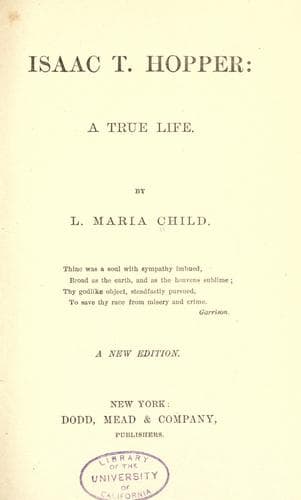
Fugitive slaves -- United States; Hopper, Isaac T. (Isaac Tatem), 1771-1852
The kind-hearted Hibernian replied, "Then they lied; for they said he
was a thief. If he is a slave, I'm sorry I stopped him. However, I will
put him in as good a condition as I found him." So saying, he went near
the man who had the fugitive in custody, and seized him by the collar
with a sudden jerk, that threw him on the pavement. The slave instantly
started, and ran at his utmost speed, again followed by the cry of "Stop
Thief!" Having run some distance, and being nearly out of breath, he
darted into the shop of a watch-maker, named Samuel Mason, who
immediately closed and fastened his door, so that the crowd could not
follow him. The fugitive passed out of the back door, and was never
afterward recaptured.
The disappointed master brought an action against Samuel Mason for
rescuing his slave. Charles J. Ingersoll and his brother Joseph, two
accomplished lawyers of Philadelphia, conducted the trial for him, with
zeal and ingenuity worthy of a better cause. Isaac T. Hopper was
summoned as a witness, and in the course of examination he was asked
what course members of the Society of Friends adopted when a fugitive
slave came to them. He replied, "I am not willing to answer for any one
but myself."
"Well," said Mr. Ingersoll, "what would _you_ do in such a case? Would
you deliver him to his master?
"Indeed I would not!" answered the Friend. "My conscience would not
permit me to do it. It would be a great crime; because it would be
disobedience to my own dearest convictions of right. I should never
expect to enjoy an hour of peace afterward. I would do for a fugitive
slave whatever I should like to have done for myself, under similar
circumstances. If he asked my protection, I would extend it to him to
the utmost of my power. If he was hungry, I would feed him. If he was
naked, I would clothe him. If he needed advice, I would give such as I
thought would be most beneficial to him."
The cause was tried before Judge Bushrod Washington, nephew of General
Washington. Though a slaveholder himself, he manifested no partiality
during the trial, which continued several days, with able arguments on
both sides. The counsel for the claimant maintained that Samuel Mason
prevented the master from regaining his slave, by shutting his door, and
refusing to open it. The counsel for the defendant replied that there
was much valuable and brittle property in the watchmaker's shop, which
would have been liable to robbery and destruction, if a promiscuous mob
had been allowed to rush in. Judge Washington summed up the evidence
very clearly to the jury, who after retiring for deliberation a
considerable time, returned into court, declaring that they could not
agree upon a verdict, and probably never should agree. They were ordered
out again, and kept together till the court adjourned, when they were
dismissed.
Public-domain text, read in full here on John Shaqi.
Reviews
Reviews
No reviews yet
Be the first to share your thoughts on this work.
Elsewhere in the archive
Join the Discussion
Join the discussion
Sign in to leave a comment or review.
Sign InorCreate an account