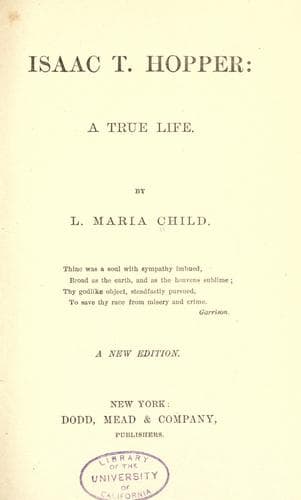
Fugitive slaves -- United States; Hopper, Isaac T. (Isaac Tatem), 1771-1852
Being a very bright, manly boy, he was intrusted to carry grain several
miles to mill, when he was only eight years old. On one of these
occasions, he arrived just as another boy, who preceded him, had
alighted to open the gate. "Just let me drive in before you shut it,"
said Isaac, "and then I shall have no need to get down from my wagon."
The boy patiently held the gate for him to pass through; but, Isaac,
without stopping to thank him, whipped up his horse, arrived at the mill
post haste, and claimed the right to be first served, because he was the
first comer. When the other boy found he was compelled to wait, he
looked very much dissatisfied, but said nothing. Isaac chuckled over
his victory at first, but his natural sense of justice soon suggested
better thoughts. He asked himself whether he had done right thus to take
advantage of that obliging boy? The longer he reflected upon it, the
more uncomfortable he felt. At last, he went up to the stranger and said
frankly, "I did wrong to drive up to the mill so fast, and get my corn
ground, when you were the one who arrived first; especially as you were
so obliging as to hold the gate open for me to pass through. I was
thinking of nothing but fun when I did it. Here's sixpence to make up
for it." The boy was well pleased with the amend thus honorably offered,
and they parted right good friends.
At nine years old, he began to drive a wagon to Philadelphia, to sell
vegetables and other articles from his father's farm; which he did very
satisfactorily, with the assistance of a neighbor, who occupied the next
stall in the market. According to the fashion of the times, he wore a
broad-brimmed hat, and small-clothes with long stockings. Being
something of a dandy, he prided himself upon having his shoes very
clean, and his white dimity small clothes without spot or blemish. He
caught rabbits, and sold them, till he obtained money enough to purchase
brass buckles for his knees, and for the straps of his shoes. The first
time he made his appearance in the city with this new finery, he felt
his ambition concerning personal decoration completely satisfied. The
neatness of his dress, and his manly way of proceeding, attracted
attention, and induced his customers to call him "THE LITTLE GOVERNOR."
For several years, he was universally known in the market by that title.
Fortunately, his father had no wish to obtain undue advantage in the
sale of his produce; for had it been otherwise, his straight-forward
little son would have proved a poor agent in transacting his affairs.
One day, when a citizen inquired the price of a pair of chickens, he
answered, with the utmost simplicity, "My father told me to sell them
for fifty cents if I could; and if not, to take forty."
"Well done, my honest little fellow!" said the gentleman, smiling, "I
will give you whatever is the current price. I shall look out for you in
the market; and whenever I see you, I shall always try to trade with
you." And he kept his word.
Public-domain text, read in full here on John Shaqi.
Reviews
Reviews
No reviews yet
Be the first to share your thoughts on this work.
Join the Discussion
Join the discussion
Sign in to leave a comment or review.
Sign InorCreate an account