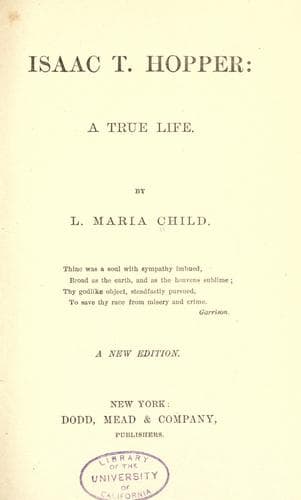
Fugitive slaves -- United States; Hopper, Isaac T. (Isaac Tatem), 1771-1852
But when he had put some heavy
stones in his pocket to make him sink rapidly, he seemed to hear a voice
calling to him to forbear; and looking up, he saw a man watching him. He
hurried away to avoid questions, and passing by a sailor's
boarding-house, he went in and offered to wait upon the boarders for his
food. They took him upon those terms; and the gentleman who had been
accustomed to ride in his own carriage, and be waited upon by servants,
now roasted oysters and went of errands for common seamen. He was in
this forlorn situation, when accident introduced him to Friend Hopper's
notice. He immediately furnished him with a suit of warm clothes; for
the weather was cold, and his garments thin. He employed him to post up
his account-books, and finding that he did it in a very perfect manner,
he induced several of his friends to employ him in a similar way.
A brighter day was dawning for the unfortunate man, and perhaps he might
have attained to comfortable independence, if his health had not failed.
But he had taken severe colds by thin clothing and exposure to inclement
weather. A rapid consumption came on, and he was soon entirely unable to
work. Under these circumstances, the best Friend Hopper could do for him
was to secure peculiar privileges at the alms-house, and surround him
with, all the little comforts that help to alleviate illness. He visited
him very often, until the day of his death, and his sympathy and kind
attentions were always received with heartfelt gratitude.
THE MUSICAL BOY.
One day when Friend Hopper visited the prison, he found a dark-eyed lad
with a very bright expressive countenance His right side was palsied, so
that the arm hung down useless. Attracted by his intelligent face, he
entered into conversation with him, and found that he had been palsied
from infancy. He had been sent forth friendless into the world from an
alms-house in Maryland. In Philadelphia, he had been committed to prison
as a vagrant, because he drew crowds about him in the street by his
wonderful talent of imitating a hand-organ, merely by whistling tunes
through his fingers. Friend Hopper, who had imbibed the Quaker idea that
music was a useless and frivolous pursuit, said to the boy, "Didst thou
not know it was wrong to spend thy time in that idle manner?"
With ready frankness the young prisoner replied, "No, I did not; and I
should like to hear how _you_ can prove it to be wrong. God has given
you sound limbs. Half of my body is paralyzed, and it is impossible for
me to work as others do. It has pleased God to give me a talent for
music. I do no harm with it. It gives pleasure to myself and others, and
enables me to gain a few coppers to buy my bread. I should like to have
you show me wherein it is wrong."
Without attempting to do so, Friend Hopper suggested that perhaps he had
been committed to prison on account of producing noise and confusion in
the streets.
Public-domain text, read in full here on John Shaqi.
Reviews
Reviews
No reviews yet
Be the first to share your thoughts on this work.
Elsewhere in the archive
Join the Discussion
Join the discussion
Sign in to leave a comment or review.
Sign InorCreate an account