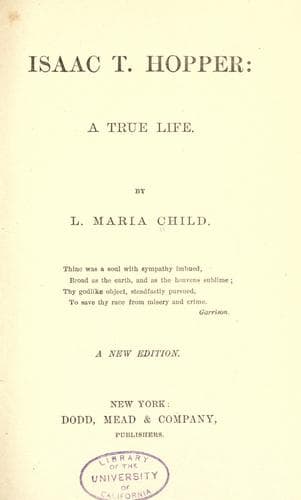
Fugitive slaves -- United States; Hopper, Isaac T. (Isaac Tatem), 1771-1852
"I make no riot," rejoined the youth. "I try to please people by my
tunes; and if the crowd around me begin to be noisy, I quietly walk
off."
Struck with the good sense and sincerity of these answers, Friend Hopper
said to the jailor, "Thou mayest set this lad at liberty. I will be
responsible for it."
The jailer relying on his well-known character, and his intimacy with
Robert Wharton, the mayor, did not hesitate to comply with his request.
At that moment, the mayor himself came in sight, and Friend Hopper said
to the lad, "Step into the next room, and play some of thy best tunes
till I come."
"What's this?" said Mr. Wharton. "Have you got a hand-organ here!"
"Yes," replied Friend Hopper; "and I will show it to thee. It is quite
curious."
At first, the mayor could not believe that the sounds he had heard were
produced by a lad merely whistling through his fingers. He thought them
highly agreeable, and asked to have the tunes repeated.
"The lad was committed to prison for no other offence than making that
noise, which seems to thee so pleasant," said Friend Hopper. "I dare say
thou wouldst like to make it thyself, if thou couldst. I have taken the
liberty to discharge him."
"Very well," rejoined the mayor, with a smile. "You have done quite
right, Friend Isaac. You may go, my lad. I shall not trouble you. But
try not to collect crowds about the streets."
"That I cannot help," replied the youth. "The crowds _will_ come, when I
whistle for them; and I get coppers by collecting crowds. But I promise
you I will try to avoid their making any riot or confusion."
MARY NORRIS.
A stout healthy woman, named Mary Norris was continually taken up as a
vagrant, or committed for petty larceny. As soon as she was discharged
from the penalty of one misdemeanor, she was committed for another. One
day, Friend Hopper, who was then inspector, said to her, "Well, Mary,
thy time is out next week. Dost thou think thou shalt come back again?"
"Yes," she replied sullenly.
"Dost thou _like_ to come back?" inquired he.
"No, to be sure I don't," rejoined the prisoner. "But I've no doubt I
_shall_ come back before the month is out."
"Why dost thou not make a resolution to behave better?" said the kindly
inspector.
"What use would it be?" she replied. "You wouldn't take me into your
family. The doctor wouldn't take me into his family. No respectable
person would have anything to do with me. My associates _must_ be such
acquaintances as I make here. If they steal, I am taken up for it; no
matter whether I am guilty or not. I am an old convict, and nobody
believes what I say. O, yes, I shall come back again. To be sure I shall
come back," she repeated bitterly.
Her voice and manner excited Friend Hopper's compassion, and he thus
addressed her: "If I will get a place for thee in some respectable
family where they will be kind to thee, wilt thou give me thy word that
thou wilt be honest and steady, and try to do thy duty."
Public-domain text, read in full here on John Shaqi.
Reviews
Reviews
No reviews yet
Be the first to share your thoughts on this work.
Elsewhere in the archive
Join the Discussion
Join the discussion
Sign in to leave a comment or review.
Sign InorCreate an account