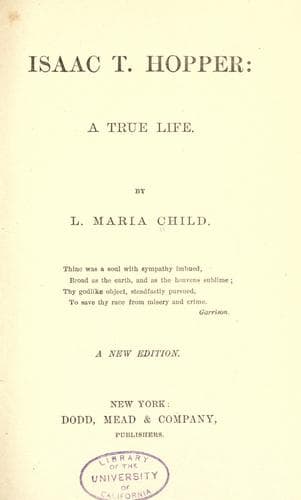
Fugitive slaves -- United States; Hopper, Isaac T. (Isaac Tatem), 1771-1852
On the eventful Fourth of July, she came out in her new dress. Lord
Henry complimented her upon her elegant appearance, but she was not
happy. On their way to the gardens, he talked to her in a manner which
she did not comprehend. Perceiving this, he spoke more explicitly. The
guileless young creature stopped, looked in his face with mournful
reproach, and burst into tears. The nobleman took her hand kindly, and
said, "My dear, are you an innocent girl?"
"I am, I am," she replied, with convulsive sobs. "Oh, what have I ever
done, or said, that you should ask me such a question?"
The evident sincerity of her words stirred the deep fountains of his
better nature. "If you are innocent," said he, "God forbid that I should
make you otherwise. But you accepted my invitations and presents so
readily, that I supposed you understood me."
"What _could_ I understand," said she, "except that you intended to make
me your wife?"
Though reared amid the proudest distinctions of rank, he felt no
inclination to smile. He blushed and was silent. The heartless
conventionalities of the world stood rebuked in the presence of
affectionate simplicity. He conveyed her to her humble home, and bade
her farewell, with a thankful consciousness that he had done no
irretrievable injury to her future prospects. The remembrance of her
would soon be to him as the recollection of last year's butterflies.
With her, the wound was deep. In the solitude of her chamber she wept in
bitterness of heart over her ruined air-castles. And that dress, which
she had stolen to make an appearance befitting his bride! Oh, what if
she should be discovered? And would not the heart of her poor widowed
mother break, if she should ever know that her child was a thief?
Alas, her wretched forebodings proved too true. The silk was traced to
her; she was arrested on her way to the store and dragged to prison.
There she refused all nourishment, and wept incessantly. On the fourth
day, the keeper called upon Isaac T. Hopper, and informed him that there
was a young girl in prison, who appeared to be utterly friendless, and
determined to die by starvation. The kind-hearted Friend immediately
went to her assistance. He found her lying on the floor of her cell,
with her face buried in her hands, sobbing as if her heart would break.
He tried to comfort her, but could obtain no answer.
"Leave us alone," said he to the keeper. "Perhaps she will speak to me,
if there is no one to hear." When they were alone together, he put back
the hair from her temples, laid his hand kindly on her beautiful head,
and said in soothing tones, "My child, consider me as thy father. Tell
me all thou hast done. If thou hast taken this silk, let me know all
about it. I will do for thee as I would for my own daughter; and I doubt
not that I can help thee out of this difficulty."
Public-domain text, read in full here on John Shaqi.
Reviews
Reviews
No reviews yet
Be the first to share your thoughts on this work.
Elsewhere in the archive
Join the Discussion
Join the discussion
Sign in to leave a comment or review.
Sign InorCreate an account